Introduction
July was hot! Utahns experienced record-setting temperatures and a few major rain and thunderstorm events. Southern and Central Utah experienced severe flooding, with some towns having to be evacuated. I was able to take out my new telescope a couple of times this month to enjoy the sights of the night sky. My main objective was to learn how to use my scope more proficiently. I need just one more clear evening, and I should be ready to tackle any situation! I am hoping for that opportunity during the last part of July.
August will be a great month for any type of observing! For the unaided eye and astrophotographers, August will offer a Total Solar Eclipse, visible in Europe, a partial Lunar Eclipse, visible across the US, and the Perseids peaking under a Moonless sky. All of the planets excluding Venus will be visible in the morning sky. Observers with binoculars or a telescope can enjoy the DSOs of the summer nights and can, of course, target the planets and Moon for better views.
 |
| Mercury |
Mercury will be visible in the morning twilight nearly the entire month of August. This tiny world will reach its greatest western elongation on the 2nd, meaning this will likely be the best morning to view the planet. On the 11th, the Earth's Moon will pass within 2° of Mercury but may be difficult to spot since it is the day before the New Moon phase and Total Solar Eclipse. The observers fortunate enough to witness this Total Solar Eclipse will be able to see Mercury during totality. The other planets will also be visible, with Jupiter being the nearest planet to Mercury. On the 15th, Mercury and Jupiter will be in conjunction with less than a degree separating the two. Unfortunately, this planetary conjunction will be difficult to spot as the pair rise less than an hour before the Sun. Any chance of seeing this conjunction will require a clear view of the eastern horizon before sunrise.
 |
| Venus |
Venus will be the only planet visible in the western sky shortly after sunset during August. Although it's the only planet in the west, it makes up for it by shining so brightly. Venus will reach dichotomy, 50% lit, near the 11th and 12th this month, coinciding with the Perseids. Venus will glide through the background stars of Virgo during the entirety of August, passing less than 5° from Porrima on the 15th and less than 2° from Spica on the 31st. A thin Crescent Moon will be close to Venus on the 15th.
 |
| Mars |
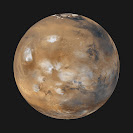
Mars rises above the mountains with Taurus the Bull around 3:00 AM at the start of the month. Due to the Red Planet's easterly motion from our vantage point, it rises just 30 minutes earlier by the 31st of August in Gemini. Mars transitions to the second constellation during the morning of the 12th, the same day as the peak of the Perseids, a Total Solar Eclipse, and the New Moon phase. On the 9th, a thin Crescent Moon will pass close by Mars. Between the 14th and 15th, Mars will pass within 1° of M35, an open star cluster at the feet of Gemini. The Red Planet lies on the other side of the solar system from the Earth and is quite dim and small in a telescope. However, astrophotographers should take advantage of Betelgeuse, Aldebaran, and Mars showing off their red glow in the eastern sky before sunrise.
 |
| Jupiter |
Saturn rises close to midnight at the start of August and about two hours earlier by the end of the month. The rings of Saturn are tilted so they are nearly edge-on for our Earthly observations, but views will improve as the Earth and Saturn orbit the Sun. This ring tilt should not discourage observers from viewing this planet! It will still offer great views and the chance to see a few of its moons. The Earth's Moon will pass close by Saturn on the 3rd and again on the 31st of August.
 |
| Neptune |
 |
| Uranus |
Uranus rises around 2:00 AM with Taurus the Bull at the start of the month and about 90 minutes earlier by the end of the month. This distant world can be found nearly halfway between M45 (The Pleiades) and Aldebaran, the red eye of Taurus. Uranus can be seen by the unaided eye from a dark sky site, but a pair of binoculars or a telescope will really help differentiate it from the other stars. With optical aid, this world will appear blue-green in color and as a disk in the field of view instead of a pinpoint of light like a star. The Earth's Moon will pass within 5° of Uranus on the 7th of August.
Neptune requires optical aid to observe with a light-pollution-free sky, improving the views tremendously. This distant ice giant will be sharing the sky with the stars of Pisces the Fish. The Moon will join Neptune on the 3rd and again on the 30th of August.
Perseids, Total Solar Eclipse, Partial Lunar Eclipse, and Tempel 2
August treats observers this month with many different things for all interests. The highly anticipated Perseid Meteor Shower returns this month and will peak on the 12th under a Moon-free sky! This gives observers the chance to view up to 100 meteors per hour if they can escape all forms of light pollution. It is best to view the Perseids after midnight, which allows Perseus, the constellation where the Perseids get their name, to climb above the northeast horizon.
A Total Solar Eclipse will occur on the same day as the Perseids peak, creating a spectacular day for observers who are in the path of totality. Unfortunately for Utahns, this eclipse favors those in Europe, Iceland, and Greenland. For those able to travel to view this eclipse, I envy you!
Near the end of August, on the 28th, Utahns as well as all of North America will experience a Partial Lunar Eclipse. The eclipse will already have started at 8:00 PM, when the Moon rises in Utah. The maximum eclipse does not occur until 10:12 PM, giving the Moon ample time to climb high in the sky. A Lunar Eclipse can be enjoyed using an optical aid, photography, or the unaided eye, which is often the preferred method of observation. The eclipse will end by 1:00 AM
Comet Tempel 2 can still be seen during the warm August nights. This comet is dimming as it moves away from the Earth and will require optical aid or a camera to see. The best chance comes in early August since Tempel 2 will be brighter, but it will be visible all month. It is visible all night as well, but observers should wait until after midnight to allow it to gain some altitude. Near the 7th of August, Comet Tempel 2 will be about as high in the sky as Saturn but further to the south (right), near but above the bright star Fomalhaut. By the 23rd, Fomalhaut and Tempel 2 will have about the same altitude around midnight. Since its location changes nightly, I recommend using a favorite astronomy app, like Stellarium or SkySafari, to find Tempel 2 in the sky.
I have planned a quick weekend trip to a dark sky site and am bringing along my telescope and camera. I hope to capture the Perseid meteors, Tempel 2, and many other wonders of the night sky! I am hopeful for cloud- and smoke-free skies!
Monthly Breakdown
August 02: Mercury reaches greatest western elongation
August 03: Moon passes within 5° of Neptune
August 03: Moon passes within 7° of Saturn
August 05: Last Quarter Moon🌗
August 07: Moon passes within 5° of Uranus
August 09: Moon passes within 4° of Mars
August 11: Moon passes within 2° of Mercury
August 12: New Moon 🌑August 12: Perseid Meteor Shower peaks
August 15: Venus reaches greatest eastern elongation
August 15: Mercury and Jupiter planetary conjunction
August 16: Moon passes within 2° of Venus
August 19: First Quarter Moon 🌓
August 27: Mercury reaches superior conjunction
August 28: Full Moon 🌕 August 30: Moon passes within 5° of Neptune
August 31: Moon passes within 7° of Saturn
 |
| Now get outside and look up! |
Planet images were taken by NASA.
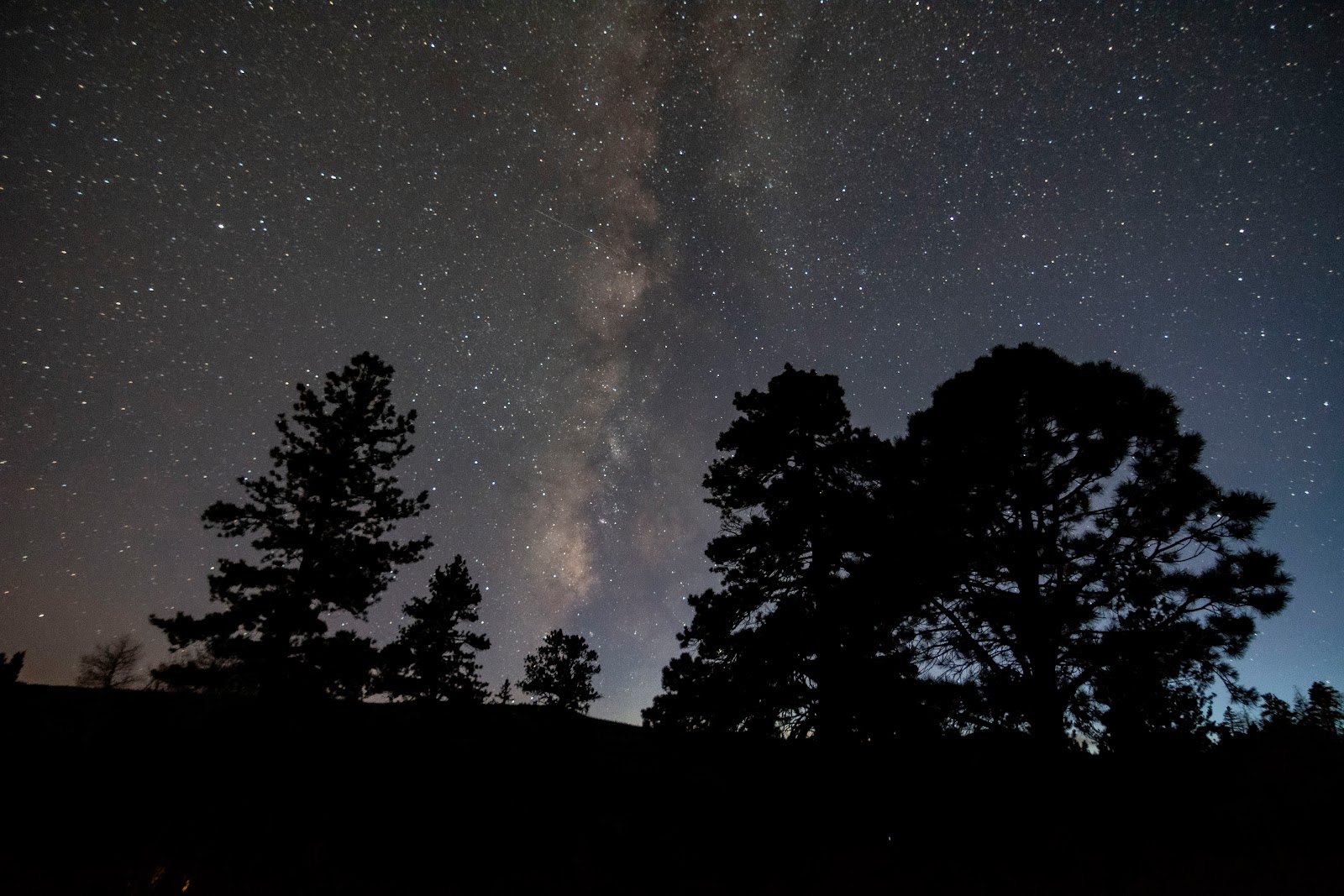
Andrew vs. the Cosmos image was taken by Jeff Greenland.The Milky Way and Trees image was taken by Andrew Greenland.
Orion, Taurus, and Pleiades image was taken by Andrew Greenland.




No comments:
Post a Comment