Introduction
September was much cooler than August, making nights out under the stars much more pleasant. Utahns did receive a few end-of-summer rainstorms, which I found quite enjoyable. I also enjoyed looking up before sunrise to see Jupiter and Orion high in the sky. I'm looking forward to more cool weather and, hopefully, clear skies to enjoy the autumn constellations and deep-sky objects.
October is typically wetter than September, and snowstorms can occur during the month, especially around Halloween. This month should be great for stargazing, with Saturn reaching opposition and the Orionid Meteor Shower peaking. Mercury will return to the evening sky but may prove difficult to see. Neptune was recently at opposition and will remain a great target for telescopes and binoculars during October. Enjoy these spectacular sights and let the night sky inspire your curiosity.
 |
| Mercury |
Mercury has transitioned to the evening sky and will be visible shortly after sunset. To spot this tiny world, try viewing during the first half of October when it's higher in the sky. Since Mercury is currently south of the ecliptic, a clear western horizon is essential, especially for Utahns with obstructed views. Use binoculars or a telescope if possible, and check local sunset times for optimal viewing windows.
 |
| Venus |
Venus may also be tricky to spot during October. This world dips below the western horizon shortly after the Sun. Venus shines brightly, which may help in detecting this world low on the western horizon. Venus is quickly approaching the Sun for an inferior conjunction, which will occur on the 23rd. A clear view of the western horizon will be required to spot Venus this month.
 |
| Mars |
Rising around 2:30 AM for Utahns, Mars will be the easiest rocky world to spot during October. The Red Planet will rise about 30 minutes earlier by month's end due to its retrograde motion. This retrograde motion will have Mars moving closer to Jupiter in our night sky, with their closest approach occurring at the end of the month. The Earth's Moon will pass close by on the 5th. Unfortunately, unless an observer has a crystal-clear night with an extremely steady atmosphere, Mars will not offer any surface detail through a telescope.
 |
| Jupiter |
Jupiter is a great early morning target or for an observer who stays out all night. Its brilliance will make it easy to spot against the background stars of Leo. The Earth's Moon will pass close by on the 6th, occulting Jupiter for those in the Eastern United States. Several Galilean Moon transits will occur this month. I recommend using the Moons of Jupiter & Saturn app to find the transit times for a specific location. Watching these transits can be a fascinating experience, inviting you to explore the dynamic nature of our solar system.
Saturn reaches opposition on the 4th, making October the best time of the year to view this world. It will remain visible from sunset to sunrise during the month, giving observers ample opportunities to view Saturn. The Earth's Moon will pass close by on the 24th. Saturn's moons constantly change position around their parent planet, allowing transits to be seen from Earth. I recommend using the Moons of Jupiter & Saturn app to find when these transits will occur at your specific location.
 |
| Neptune |
 |
| Uranus |
Uranus will remain between the Pleiades and Hyades star clusters of Taurus throughout October. We are only a month away from this world reaching opposition from our vantage point. You can see Uranus with the unaided eye from a dark-sky site on a moonless night, though it's easier to distinguish it from the background stars with a telescope or pair of binoculars. Earth's nearly Full Moon will pass close to Uranus on the 28th.
Neptune reached opposition in late September and will remain a great target throughout October. This world will be visible from sunset until sunrise in Pisces. Wait until close to midnight for this distant world to rise high in the sky. Neptune will require optical aid to view and will appear as a blue disk against the pinpoint background stars. If an observer can locate Saturn, Neptune is a little further southwest along the ecliptic since it rises above the horizon shortly before the Ringed World. The Earth's own Moon will pass close by on the 23rd.
Orionid Meteor Shower
We've had a brief period with no major meteor showers; October will remedy that with the Orionid Meteor Shower! As the name suggests, these meteors will appear to radiate from the constellation of Orion. These meteors are active from October 2nd to November 7th, peaking on the 21st. During a Moon-free peak, observers could expect up to 20 meteors per hour, but this year a First Quarter Moon occurs three days before, meaning the Moon won't set until about 4:00 AM and will obscure all but the brightest meteors. This year, observers should plan to venture outside after 4:00 AM for a chance to see nearly the max rate of 18 meteors per hour.
Monthly Breakdown
October 03: Last Quarter Moon🌗
October 04: Saturn reaches opposition
October 05: Moon passes within 1° of MarsOctober 06: Moon passes within 0.5° of Jupiter
October 10: New Moon 🌑
October 11: Moon passes within 3° of Venus
October 12: Mercury reaches greatest eastern elongation
October 12: Moon passes within 2° of Mercury
October 18: First Quarter Moon 🌓
October 21: Orionid Meteor Shower peaks
October 23: Moon passes within 5° of Neptune
October 23: Venus reaches inferior conjunction
October 24: Moon passes within 7° of Saturn
October 26: Full Moon 🌕
October 28: Moon passes within 5° of Uranus
 |
| Now get outside and look up! |
Planet images were taken by NASA.
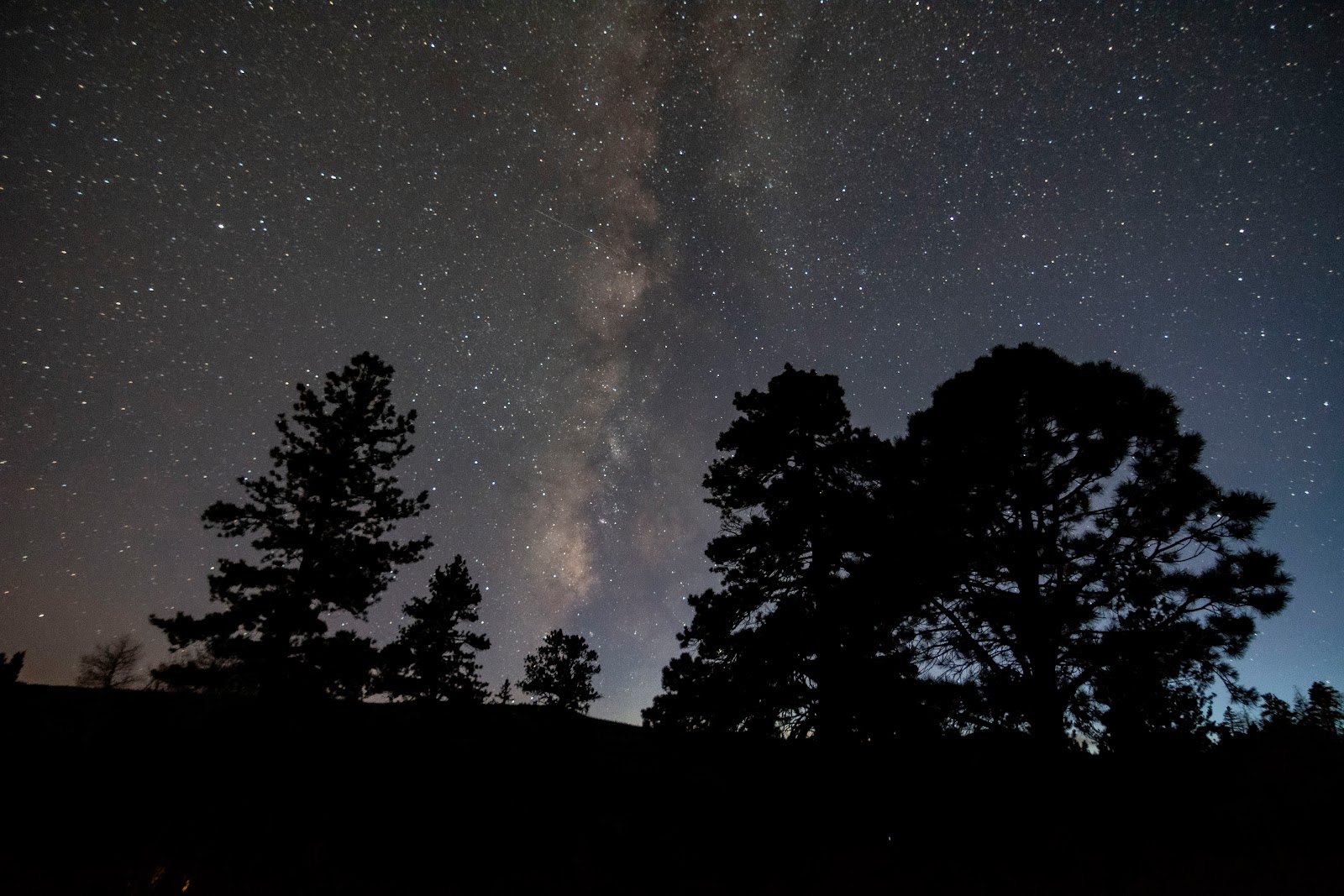
Andrew vs. the Cosmos image was taken by Jeff Greenland.The Milky Way and Trees image was taken by Andrew Greenland.
Orion, Taurus, and Pleiades image was taken by Andrew Greenland.