Friday, May 1, 2026

Monthly Night Sky Report: May 2026

                      Introduction

   April was a great month for space news! The Artemis II crew launched on April 1st and returned on the 10th with great success. As far as stargazing, April was kind of mixed again for Utahns. We did experience some warm temperatures and clear nights, but also had a few rain and snow storms mixed with cold temperatures. As is typical in my experience, stormy weather occurs on the days that work best for my stargazing schedule. I'm hoping to finally catch a break during May!

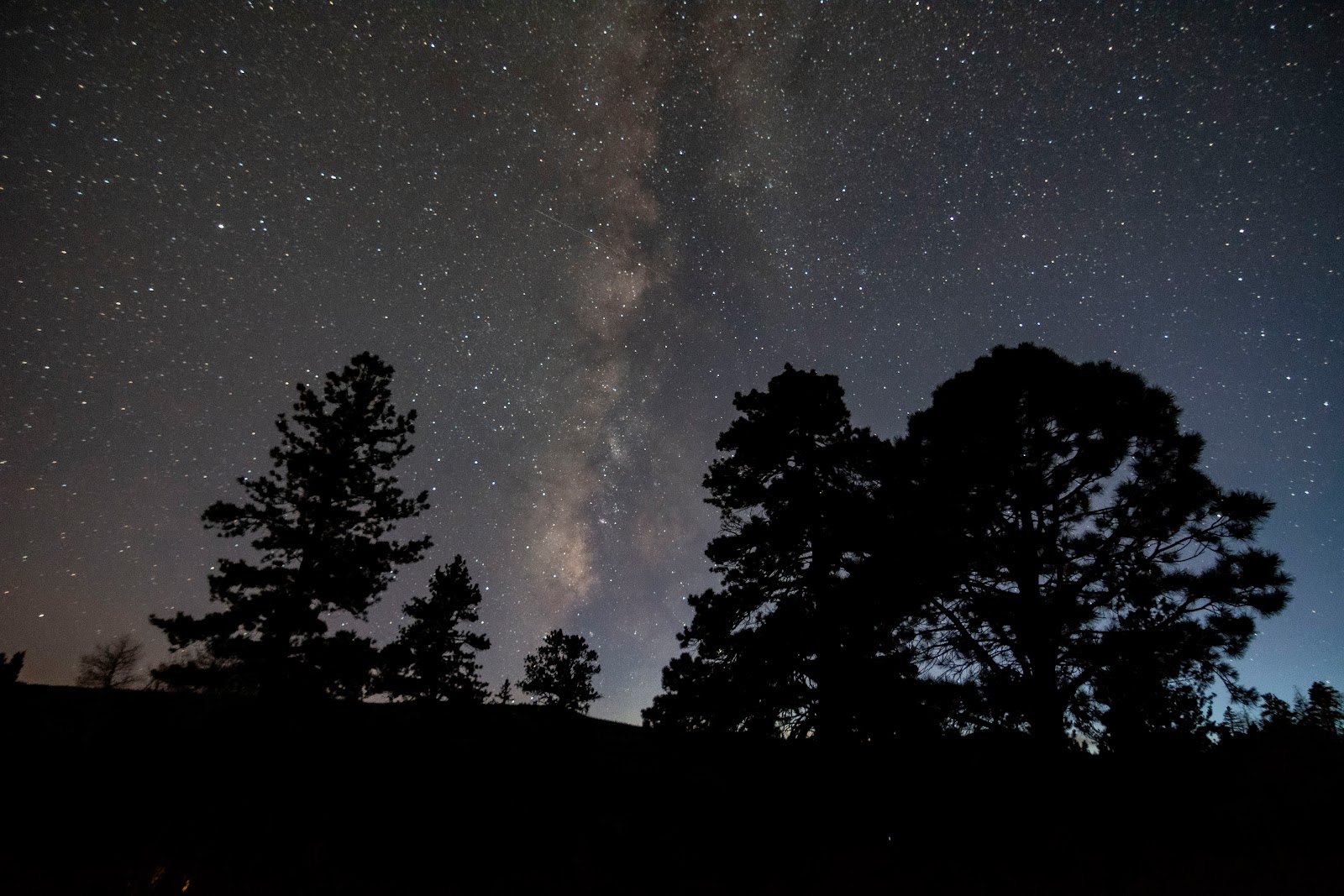
    May should offer warmer temperatures and fewer storms than April over Utah. Obviously, the weather is going to do whatever it wants, when it wants, so before loading up and taking all of your astronomy gear to a dark sky location, check the weather! May will experience a "Blue Moon" or two full moons in a single month. The Eta Aquariids Meteor Shower will peak this month. Jupiter and Venus won't quite experience a planetary conjunction this month, but they are moving ever closer to one another in our night sky. May also begins the season of the Milky Way Bands' core marching across the night sky. It will rise shortly after midnight during the first week of the month and will rise earlier with each passing night.    


Mercury


   Mercury will transition from being found in the morning sky before sunrise to being visible shortly after sunset. This tiny world will be difficult to spot against the Sun's morning glow during the first half of the month. It will reach solar conjunction on the 14th, passing behind the Sun as seen from Earth. As it emerges from behind the Sun, Mercury will transition to an evening object on the western horizon. The best chance to see Mercury will come at the end of the month when it lies furthest from the Sun during the month of May. It will continue to pull away from the Sun during the early part of June.   

  
Venus

   Venus will remain easy to find in the evening sky after sunset throughout May. It is the third brightest natural object in the sky, only to be outshone by the Sun and the Moon. As the days fly by in May, Venus will be found rising higher above the western horizon if it's viewed at the same time after sunset each evening. A very thin crescent Moon can be seen close by on the 18th. Venus starts May residing among the stars of Taurus, but by the end of the month, this bright planet will be found in Gemini with Jupiter. Stay tuned for their planetary conjunction next month!  
    
Mars
    
   Mars can still be found rising above the eastern horizon shortly before the Sun during May. It averages approximately magnitude 1.25 during the month and will be hard to spot against the brightening morning sky. The best chance will come towards the end of the month when the Red Planet rises above the horizon approximately an hour before the Sun. Mars currently lies about 2.2 AU from the Earth, which is over twice as far as the Earth-Sun distance! This places the Red Planet on the far side of the Sun from our perspective, causing it to appear smaller and dimmer. Mars will be found in Pisces during May, with a thin crescent Moon joining this planet on the 14th.


Jupiter
Saturn


   Jupiter is sinking below the horizon earlier with each passing day, so observers should view this giant planet before it reaches conjunction with the Sun! The evenings are warming up, making it a great time to stargaze and observe this planet. It can still be found hanging out with the stars of Gemini and can easily be seen even in the early evening sky before the Sun's glow has completely faded.  As the weather continues to warm up this month, I encourage interested observers to use the Moons of Jupiter and Saturn app for Android or Gas Giants for iOS devices to determine when the Galilean Moons and the Great Red Spot transit Jupiter. Both of these apps are free. If an observer is interested in a paid, more comprehensive app, I recommend Stellarium Plus for Android and iOS, and SkySafari Pro for iOS. The Earth's own Moon will be close to Jupiter on the 19th and 20th of this month.  

  Saturn can be found in the early morning sky near Mars at the start of May. However, the Ringed World will fare better than Mars this month as it increases its distance from the Sun. The best time to view Saturn will be at or near the end of the month, when it rises about two hours earlier than the Sun. It can also be found in Pisces and will have the Moon as a companion on the 13th.


Neptune
Uranus


   Uranus will be difficult to see in May. The two things that will make Uranus hard to see this month are its great distance from the Earth, which makes it quite dim, shining at magnitude 5.8, and its ever-decreasing proximity to the Sun from our Earth-bound view, which will cause this planet to be lost in the bright glow of the Sun. The best chance to see Uranus will come early in the month when it is highest above the western horizon, which is really only a few degrees at 9:15 on the first evening of May. By midmonth, Uranus will reach solar conjunction and will be visible in the morning sky in June.  

   Neptune wants to be seen! Unfortunately, this distant planet will be hard to see during May as it rises just a couple of hours before the Sun. Saturn rises shortly after Neptune, so if an observer can see Saturn in the early morning sky, use it as a guide to find Neptune, which is just a few degrees to the upper right (southeast) of the ringed world. Neptune will be easiest to spot as we move towards the end of May. This gives this ice giant time to clear the eastern horizon well before the Sun's glow starts to invade the inky blackness of the night sky. Neptune can be found among the stars of Pisces with a thin crescent Moon joining it on the 13th. On this date, the Moon will be nestled nicely between Saturn and Neptune.


Eta Aquariids, Moon, and Comet Tempel 2

    The Eta Aquariid Meteor Shower will return this month. This shower is active between April 19th and May 28th, with the peak date falling on the morning of May 6th. During a good year, northern hemisphere observers can expect to see between 10 and 30 meteors per hour. Unfortunately, this year, a waning gibbous Moon will interfere, limiting this number to fewer than 10 meteors per hour. Observers should not be discouraged, as this is a good time to practice their meteor observing skills and find the best gear that suits each individual's needs for a comfortable night of meteor spotting. Aquarius, the apparent radiant of the Eta Aquariids, will begin to rise above the eastern horizon around 3:30 for Utahns. 

    May offers two Full Moon phases this month! The second Full Moon of the month, any month, is called a "Blue Moon." May will see a Full Moon on the 1st and 31st this month. I personally prefer to observe the Moon when it is not fully illuminated by sunlight, but I have yet to capture an image of the Full Moon with my smart telescope. This month I will get two opportunities! This month's Blue Moon will be considered a "Micro Moon," meaning it will appear slightly smaller than the average Full Moon, as compared to a Super Moon, which appears slightly larger than the average Full Moon.

    Finally, we have Comet 10P/Tempel, more commonly known as Tempel 2. This comet is slowly brightening in the early morning sky and will be visible throughout the summer. On the 8th, Tempel 2 can be found near Aquila, the constellation that contains the bright star Altair, which rises above the eastern horizon around midnight. Observers who are able to stay out all night should try to catch Tempel 2 before the Moon rises at 2:30 AM. As mentioned in the introduction, the Milky Way Core will be rising above the horizon close to this same time. In fact, Tempel 2 can be found just below the Milky Way Band on the 8th, but will move farther away and closer to the horizon as the month continues. Tempel 2 will also brighten as the month progresses, making it easier to spot in the predawn sky.      


Monthly Breakdown


May 01: Full Moon 🌕
May 06: Eta Aquariid Meteor Shower peaks 
May 10: Last Quarter Moon🌗 
May 17: New Moon 🌑
May 23: First Quarter Moon ðŸŒ“ 
May 31: Full Moon 🌕 Blue Moon


Now get outside and look up!
Planet images were taken by NASA.
Andrew vs. the Cosmos image was taken by Jeff Greenland.
The Milky Way and Trees image was taken by Andrew Greenland.
Orion, Taurus, and Pleiades image was taken by Andrew Greenland.


Tuesday, April 14, 2026

Midmonth Check-In: April 2026 and Artemis


  Introduction and Monthly Reminders   

    What's up with the weather?! I know I have brought this up a lot lately, but the weather has been so inconsistent over the past few weeks. In Northern Utah, we have experienced 80° weather followed by freezing temperatures and snow, only for the temperatures to jump back into the 70's. Not to mention the storms usually arrive on the weekends, when most observers have the chance to take out their astronomy gear to enjoy the night sky! We will catch a break soon, I'm sure. 

    Artemis 2 successfully launched on April 1st at approximately 4:35 PM for Utahns. I was able to listen to most of the prelaunch program while at work. When the hosts announced that there were only a few minutes to launch, I paused my work (don't tell my boss!) and grabbed my phone to watch the launch live. It was such an amazing experience to watch on my mobile device, so I can only imagine how those who witnessed the launch with their own eyes must have felt. This launch has certainly reinvigorated and reinforced my love for astronomy, physics, and math & science in general. 

    The four astronauts safely returned to Earth on Friday, April 10th. I was able to watch and listen to the whole event, which was quite an amazing experience in my opinion. I'm sure my wife would have preferred to watch or do something else, but I appreciate her letting me stream the event. 

    The second half of April still has lots to offer observers. The upcoming major meteor shower, the Lyrids, peaks during the morning hours on the 22nd. There is also a rare triple planetary conjunction on the 20th involving Mercury, Saturn, and Mars. This conjunction occurs shortly before sunrise and may require binoculars or a telescope to tease out Mars and Saturn in the brightening morning sky. Jupiter remains a great target for binoculars and telescopes for the remainder of the month, too. Don't forget about Comet C/2025 R3 (PanSTARRS), which will reach peak visibility during the middle of April in the constellation Pegasus. 


Future of Artemis

    Last month, I was planning on covering a different topic for this midmonth post, but I am on such an Artemis high, and I hope others are as well, that I thought a discussion on the future of the Artemis program would be a better topic. I won't go into much detail on the missions because they're likely to change, but I'll provide a general overview of the current plans.

    I'll begin at the beginning, with Artemis 1. This mission was launched on November 16th, 2022, and returned to Earth 25 days later on December 11th. The purpose of this mission was to test the new Space Launch System (SLS) rockets and the Orion spacecraft. When it returned to Earth, it also gave crews the chance to practice for when astronauts return to Earth in the same capsule. It also allowed for the recovery of the capsule and testing the equipment to do so. 

    Following Artemis 1, we had Artemis 2, of course. Between the first and second missions, engineers fixed known issues to improve future missions and ensure the astronauts on board would be safe. There was a leak in Artemis 2, which caused the mission to be postponed while it was evaluated and fixed before launch on April 1st. A few more minor issues occurred during the mission, including a faulty fan and pump in the Universal Waste Management System (the toilet), which were fixed during the mission, and some radio issues after splashdown. These and other issues will be resolved before the launch of Artemis 3.

    Artemis 3 is scheduled to launch sometime in 2027 and will test the docking capabilities of Orion and other spacecraft in low Earth orbit. It will also test the integrated operations of SpaceX and/or Blue Origin's commercial landers designed to land on the Moon.

    Artemis 4 is expected to launch in 2028 and will send humans back to the Moon. Not just to orbit, but also to land on the surface near the South Pole to take samples of this region for a potential future Moon base.

    I've been asked why the Artemis mission is such a big deal, since we have already been to the Moon, conducted science experiments on the surface, and collected rock and dust samples. And why not use the old launch vehicle, like the Saturn V, used during the Apollo Era? The second part is a short and easy-to-answer question. The Saturn V is old technology. The new SLS rocket is more efficient and is designed for longer missions than the Saturn V and the Apollo program was. The Apollo mission was to put a human on the Moon and learn more about its surface, geology, and plate tectonics. 

    This leads to the first question: why is Artemis a big deal, and why go back to the Moon? For me, Artemis is a big deal because it's about space exploration, which I love and am deeply interested in. I would love to travel to another planet and fly between the stars. While I know that I, personally, will never get to do those things, and flying between the stars will never happen in my lifetime, I believe that one day we will have the technology and means to do that, and the Artemis program is a stepping stone for that, just like the space programs were that came before, like Apollo and Mercury. Going back to the Moon is a jumping point for getting humans to Mars and beyond. The Moon is a good starting point because it is close, only 250,000 miles (!) away, so it's easier to get to and get humans back to Earth if the need arises. While a Moon base and the permanent establishment of humans on the Moon are several years away, we need to study the environment so we know what we would need to take with us and what can be utilized on the Moon's surface. Perhaps more importantly, by building a base on the Moon, fewer resources would be required to travel to Mars and beyond. Leaving Earth's surface requires multistage rockets to reach a velocity of 11.2 km/s. Leaving the surface of the Moon requires only approximately 2.4 km/s due to its lack of atmosphere and weaker gravitational pull. 

    There are also economic and political reasons for having a permanent base on the Moon. While these reasons don't interest me as much, others may find them important. The Moon has valuable resources that can be mined or otherwise extracted for use in manufacturing and industry. Political matters interest me even less since I believe we should all be working together or at least competing in a way that allows each competitor to grow stronger, but unfortunately, not everyone feels the same. 

    Perhaps the most important part of the Artemis program is to get individuals interested in space and the sciences in general.          

    Show that you support dark skies, like me, by being one of the first Utahns to get a Dark Sky license plate! Visit Dark Sky Utah to apply for a new license plate for your vehicle. 


Now get outside and look up!
   

Tuesday, March 31, 2026

Monthly Night Sky Report: April 2026

                     Introduction

   The temperatures in March set records not only in Utah but also in several other states. The warmer temperatures are nice for outdoor activities, but not so good for Utah's water situation. I suppose on the upside, we have been experiencing clearer skies for stargazing! I have been enjoying looking at Jupiter and Venus in the evening sky, along with the familiar winter constellations, as they set earlier each night. I am planning on a quick outing with my new scope during the final few days of March. Of course, there is currently cloudy weather on the horizon, but hopefully it will be clear enough to enjoy a few hours under the stars.  

    Historically, April brings rain showers and wet weather, but with the current trend, who knows what we will get?! This month brings the return of a meteor shower to our skies after a two-month break. Most of the planets will theoretically be visible this month, with a few being harder to spot due to their proximity to the Sun. There may also be a few comets visible during April, with one possibly becoming visible to the unaided eye.        

    Artemis II is currently expected to launch on April 1st, sending four astronauts around the Moon. Stay up-to-date with the Artemis Mission here or with your favorite news source.


Mercury


   Mercury can be found above the eastern horizon before sunrise during April. This tiny world will reach its greatest western elongation on the 3rd, perhaps making this the best time to view as it rises about 45 minutes before the Sun. Mercury doesn't offer any planetary detail, and the only benefit of viewing this tiny world through a telescope or binoculars is to help more easily identify it in the glow of the rising Sun. On the 15th, a thin crescent Moon will join Mercury in the sky. On the 20th, Saturn and Mars may also be seen just before sunrise. Perhaps we could call this time of morning the "House of the Rising Sun?" On the 20th, these three planets will all lie within 2° of one another. A pair of binoculars or a telescope with a low-power eyepiece may be required to see the faint pinpoint light of Saturn and Mars. Mercury should stand out, shining at magnitude -0.2 this morning, so target this world while trying to spot Saturn and Mars in the sunrise glow.    

  
Venus

   Switching to the evening sky and the western horizon, Venus can be found proudly shining before the Sun's glow fades into darkness. Venus will begin April, hanging amongst the stars of Aries, the Ram. As the month progresses, Venus will slide over to the neighboring constellation of Taurus. The famous Pleiades can be found just a few degrees above this bright planet on the 18th. Uranus has been found close to the Pleiades over the past few months and will join Venus in the night sky on the 23rd when the pair will be less than 1° apart. By the 25th, Venus will have moved to the left of the Pleiades in the evening sky. This month will likely be the last time to view the Pleiades until the winter constellations reemerge later this year.  
    
Mars
    
   Mars can be found in the "House of the Rising Sun" region of the sky near Mercury during April. On the 20th, Mercury and Saturn can be found within 2° of the Red Planet; a pair of binoculars or a telescope may be required to pick out the dim Martian glow from the brightening morning sky. Mars will continue to rise earlier each day, but won't be easy to spot until later this year.


Jupiter
Saturn


   Jupiter will remain a great target for the unaided eye, binoculars, or a telescope throughout April. This gas giant will be easy to see after sunset among the background stars of Gemini. Several of the Galilean Moon transits will occur this month, and many chances to see the Great Red Spot will present themselves. As the weather warms up this month, I encourage interested observers to use the Moons of Jupiter and Saturn app for Android or Gas Giants for iOS devices to determine when these transits occur at their location. Both of these apps are free. If an observer is interested in a paid, more comprehensive app, I recommend Stellarium Plus for Android and iOS, and SkySafari Pro for iOS. The Earth's own Moon will pass close by Jupiter on the 22nd of this month.  

  Saturn can be found in the "House of the Rising Sun" in April, alongside Mercury and Mars. The trio of planets can be found within 2° of each other on the 20th, creating quite the planetary conjunction. A pair of binoculars or a telescope with a low-power eyepiece will be required to view the dim planets against the brightening background sky.


Neptune
Uranus


   Uranus will continue to be found close to the Pleiades during April, but will soon be lost from view as it nears solar conjunction. For the time being, Uranus will be above the western horizon and above brilliant Venus during the first half of the month. While Uranus moves closer to the horizon, Venus will climb higher until the pair of planets meet on the 24th, at which point they will be less than 1° apart.  

   Neptune recently reached solar conjunction and will be lost from view during April. It will return to our morning sky soon!


Lyrid Meteor Shower and Comets

    The Lyrid Meteor Shower returns this month, ending a two-month major meteor shower drought! The Lyrids are active from April 14th until the 30th, with the peak occurring in the predawn sky on the 22nd. The almost first-quarter Moon will sink below the horizon around 1:00 AM on this date, making this the best time to search for these shooting stars. The Lyrids will appear to radiate from the constellation Lyra, which rises in the early evening sky and will reach the zenith shortly before the Moon sets. The maximum rate on the 22nd is approximately 20 meteors per hour. This isn't one of the more active showers, but a dark sky site after Moonset will increase the chance of spotting the Lyrids. 

    The most exciting and unpredictable of the comets visible this month is the newly discovered Comet C/2026 A1 (MAPS). It's also being called the "Easter Comet" as it will pass close to the Sun on April 4th. This means the comet will either break apart or the heat from the Sun could trigger an outburst, potentially making Comet MAPS visible to the unaided eye...during daylight hours! If it does survive, it will be visible in the western sky after sunset. The Southern Hemisphere will have the best views, but Northern Hemisphere observers should still be able to at least see its tail.

    Comet 10P/Tempel, aka Tempel 2, is returning to our skies and should be visible throughout much of the summer. Observers should begin to look for Tempel 2 from a dark sky location on the 12th near the constellation Scutum. This region of the sky rises above the eastern horizon near 2:00 AM. A telescope or a long-exposure image will be needed in April to spot Tempel 2, but it is expected to double its brightness by August. 

    The final known comet to watch during April is Comet C/2025 R3 (PanSTARRS). It is currently visible in the constellation Pegasus, which rises above the eastern horizon shortly before sunrise. The best time to view this comet will come around midmonth, about an hour or so before sunrise, still hovering among the stars of Pegasus. A pair of binoculars, a telescope, or an imaging setup will be required to view this comet during its brief visit. 


Monthly Breakdown


April 01: Full Moon 🌕
April 03: Mercury reaches greatest western elongation 
April 10: Last Quarter Moon🌗 
April 15: Moon passes within 5° of Mercury
April 15: Moon passes within 4° of Mars
April 16: Moon passes within 5° of Saturn   
April 17: New Moon 🌑
April 19: Moon passes within 5° of Venus
April 19: Moon passes within 5° of Uranus
April 19: Mercury and Mars pass within 2°
April 20: Mercury and Saturn pass within 1° 
April 20: Mars and Saturn pass within 1° 
April 22: Lyrid Meteor Shower peaks
April 22: Moon passes within 4° of Jupiter
April 23: First Quarter Moon ðŸŒ“ 
April 24: Venus and Uranus pass within 1° 


Now get outside and look up!
Planet images were taken by NASA.
Andrew vs. the Cosmos image was taken by Jeff Greenland.
The Milky Way and Trees image was taken by Andrew Greenland.
Orion, Taurus, and Pleiades image was taken by Andrew Greenland.


Sunday, March 15, 2026

Midmonth Check-In: March 2026 and Music & Astronomy


  Introduction and Monthly Reminders   

     The weather so far this March has been off the rails! Utah started the month off with a few major rain and snowstorms, blocking the Total Lunar Eclipse on the 3rd from view, of course. I was hoping for clear skies, but wasn't surprised by the timing of the storms and cloud cover. After the storms, the temperatures shot up to 60°+ for the daily high with many clear nights. 

    I'm hoping that the clear weather and mild temperatures continue so that I, and all other stargazers, can enjoy the night sky. I am anxious to get my telescopes back out under the stars where they belong! Observers can still count on seeing many of the DSOs from the Messier Catalog during the remainder of March. The New Moon phase is quickly approaching, making it a great time to view these faint fuzzies. During the New Moon phase, the Zodiacal Light will be easy to spot in the west after sunset. A camera capable of taking long-exposure images will also be beneficial.  


Music and Astronomy

    I have always had a great love of music and almost constantly have something playing. Even now, as I write this post, I have my Stargazing Ambient playlist on in the background. Perhaps some of my readers will find it surprising that astronomy and music are connected. I'm not talking about musicians writing songs with astronomy-related lyrics, like Space Oddity by David Bowie, or music written with the heavens in mind, like The Planets by Gustav Holst, or even astronomers being popular musicians like Brian May, an astrophysicist who is also a member of Queen. I'm talking about how music and astronomy are both based on vibrations and waves.

    Sounds are created by vibrations in the air that the ear can pick up. These vibrations can be caused by any number of things, a few of which could be from me attempting to play a song on a guitar, the sound of my telescope eyepiece hitting the ground when I drop it, and the choice, usually explicit, words that come out of my mouth when this happens. All of these vibrations are just sound waves traveling through the air at frequencies measured in Hertz (Hz) that the human ear can detect. Frequency determines the sound we hear. A high frequency is a higher-pitched, shrill sound, like a siren or whistle. A low-frequency, low-pitched sound could be, for example, thunder or a bass drum. It is important to note that the volume is not related to the frequency or pitch of a sound, regardless of how it sounds to the human ear. The low E string on my guitar, when tuned correctly, has a frequency of approximately 82.4 Hz. This frequency does not change, no matter how hard or soft I pluck the guitar string. Similarly, if I pluck the high E string, it produces a frequency of approximately 330 Hz, a much higher, shrill sound compared to the low E string. Again, this pitch does not change if I pluck the string hard or soft.     
    When studying the night sky, astronomers are looking at different light, radio, or gravitational waves, depending on the instrument, if any, that is used. Light waves, like sound waves, come in many different frequencies, with the human visible range between 380 and 750 nanometers (nm). The violet color corresponds to the lower end of the visible spectrum, 380 nm, while red corresponds to the high end at 750 nm. While observing the night sky, it's easy to see that stars have different colors, meaning they emit light at different wavelengths. For example, Aldebaran, the red star in Taurus, has a color wavelength of approximately 741 nm, while Procyon, the brightest star in Canis Minor, has a wavelength of approximately 440 nm, corresponding to a blue-violet color. Interesting fact: several of the brightest stars in the sky, such as Sirius, Rigel, and Vega, have peak wavelengths in the ultraviolet range, which is outside the visible spectrum for humans. However, because these stars produce so much light, some of it "leaks" into the visible spectrum for humans to see.

    Math is all around us, including in music and astronomy. In music, there is often harmony between the notes played on instruments and the sound of the singing voice. One simple example of harmony can be demonstrated using a single string on a guitar. It does not matter which string, but I will use the low E string as an example. As mentioned earlier, when in tune, the frequency of this string when plucked is 82.4 Hz. I can then press the 12th fret, which produces another E note, an octave higher, at 164.8 Hz. The 12th fret on most guitars essentially makes the string half as long, so it has a frequency, or pitch, twice as high, creating a 2:1 ratio. Since both of these are an E note, they are said to be in harmony. There are several other types of harmony, but I just wanted to demonstrate the octave.  

    Astronomy also offers examples of harmony amid chaos. The first example that comes to my mind is the three largest inner moons of Jupiter: Io, Europa, and Ganymede. For every four orbits Io completes, Europa completes two, and Ganymede completes one. This is known as an orbital resonance and can be expressed as a 4:2:1 ratio in this example. 

    In the past, I shared a link to different sounds in space, such as the sounds of the planets. Since space is a vacuum, how do we get these sounds? The sound of the planets was created by collecting electromagnetic, radio, and plasma-wave data and translating it into a frequency humans can hear. Some people find these sounds scary or creepy, but I find most of them quite relaxing. This is the best link I could find to demonstrate the sounds of our solar system; it even includes Pluto! Recently, images from space have also been converted to sound. While it's not the actual sound picked up from the cosmos, it is still quite fascinating. The process involves taking an image and converting the location, color, and brightness of each pixel into sound. For example, a star on the top of the image will have a higher note than a star on the bottom of an image. The brightness translates into a louder note, while the color could be a different instrument. Both of these techniques are called sonification. Here is the link to NASA's Sonifications page, which includes the sounds. They even let you create your own!            

    In review, music is patterns of sound frequencies, while astronomy is patterns of light frequencies. Both of these reveal that the universe is a deeply mathematical and rhythmic place! 

Artemis II Update: This spacecraft and four astronauts are expected to launch on April 1st, with the SLS returning to the launchpad around March 19th. The intended mission is to fly around the Moon before returning to Earth.    

    Show that you support dark skies by being one of the first Utahns to get a Dark Sky license plate! Visit Dark Sky Utah to apply for a new license plate for your vehicle. 


Now get outside and look up!
   

Saturday, February 28, 2026

Monthly Night Sky Report: March 2026

                    Introduction

   The last two weeks of February in Utah received some rain, snow, and colder temperatures, making stargazing difficult or impossible. Even with the cloud cover on most nights and mornings, I was still able to spot Jupiter, several of the winter constellations, and the Moon moving across the night sky. 

    March should prove to be a great month for stargazers, weather permitting, of course. The most notable events include a Total Lunar Eclipse, running the Messier Marathon, and the chance to see the Zodiacal Light. The Vernal (Spring) Equinox occurs this month as well. Saturn and Neptune will reach conjunction with the Sun and will be lost from view during most, if not all, of March.       

    Due to a few setbacks, the Artemis II mission has been delayed and is not expected to launch before April. The Space Launch System (SLS) has been rolled back to the Vehicle Assembly Building to address a few remaining issues, with a helium leak as the primary culprit. Stay up-to-date with the Artemis Mission here or with your favorite news source.


Mercury


   The innermost planet, Mercury, will hide from us Earthlings for most of March as it reaches inferior conjunction with the Sun on the 7th. The Moon will pass close by Mercury on the 17th, but this world will still be too close to the horizon to spot. But by the end of the month, Mercury will rise earlier and climb high enough to escape the morning glow of the Sun to be seen above the eastern horizon.    

  
Venus

   Venus will remain in the western sky after sunset during March. It will easily outshine all other objects in its region of sky except for the elusive thin Crescent Moon on the 19th and 20th. The Moon will be closer to Venus and 5% lit on the 20th. On the 7th and 8th, a dim Saturn can be found close to Venus. A pair of binoculars will help observers spot the Ringed World.  
    
Mars
    
   Mars can be found near Mercury but is still too close to the Sun in March, hiding its red glow from Earth.


Jupiter
Saturn


   Jupiter will remain a great target for the unaided eye, binoculars, or a telescope throughout March. It can easily be picked out among the stars of Gemini as it shines brightly at -2.3 magnitude on the first night of the month and dims by only 0.13 magnitude by the end of the month. Several of the Galilean Moon transits will occur this month, and many chances to see the Great Red Spot will present themselves. As the weather warms up this month, I encourage interested observers to use the Moons of Jupiter and Saturn app for Android or Gas Giants for iOS devices to determine when these transits occur at their location. Both of these apps are free. If an observer is interested in a paid, more comprehensive app, I recommend Stellarium Plus for Android and iOS, and SkySafari Pro for iOS. The Earth's own Moon will pass close by Jupiter on the 26th of this month.  

  Saturn will be difficult to spot during the month as it approaches the Sun. The best time to view the Ringed World is early in the month, with the 7th and 8th likely the best opportunities, as this planet lies close to Venus. A pair of binoculars will help reveal Saturn's faint glow. Saturn will reach conjunction with the Sun on the 25th.


Neptune
Uranus


   Uranus will continue to float near the Pleiades during March. Glowing dimly at approximately 5.7 magnitude, this ice giant is technically within range of being seen by the unaided human eye. A dark sky location and good visibility will be required to tackle this feat. My eyes aren't quite good enough anymore to see this planet without the aid of binoculars or a telescope. Through a telescope, Uranus will have a noticeable blue-green tint and will appear as a disk in the field of view instead of the pinpoint of a star, making it easy to tell if this planet is in the field of view. The Earth's Moon will pass close by on the 23rd.      

   Neptune, the outermost planet, will be difficult to spot during March. It can be found close to Saturn in the evening twilight after sunset. Neptune will require a clear view of the western horizon and a pair of binoculars or a telescope to see. It reaches solar conjunction on the 22nd but will return to our morning sky in the future.


Eclipse, Zodiacal Light, and Messier Marathon

       Comet Wierzchos is still visible in the early evening sky during March with optical aid. It can be found wandering through Cetus and Eridanus during the first two weeks of March as it approaches Taurus, and more specifically, Aldebaran, the red eye of the Bull. Comet Wierzchos will rapidly dim as it moves away from the Earth and returns to the outer solar system. 

    The Zodiacal Light will continue to be a sight to see during March. This month is a particularly great time to spot this ethereal glow as the Vernal (Spring) Equinox occurs. Anytime after the 8th will be great, as the Moon's glow won't affect the western horizon as much. Of course, the evenings surrounding the New Moon phase (March 18th) will be the ideal time to view the Zodiacal Light. No special equipment is required; however, a long exposure image will gather more light than the human eye can. Just point the camera to the west after the sky darkens! A wide-angle shot is usually preferable. 

    Utahns will be treated to a Total Lunar Eclipse in the early morning hours of March 3rd. This event will likely be the highlight for most observers this month. The eclipse will begin at 1:45 AM on the 3rd and will continue until the Moon sinks below the western horizon at approximately 7:00 AM. Totality will occur at 4:34 AM, so observers interested in only seeing the Blood Moon should set their alarms for this time! Weather permitting, I plan on setting up my smart telescope to capture the entire event. I have checked the weather several times, with some forecasts showing clear skies while others are predicting clouds and rain. At the very least, I would love to get an image of the Moon during totality. 

    March is the best time of the year for a Messier Marathon. The first weekend in March is the best time for Utahns, as most of the Messier Catalog will be above the horizon throughout the night. The only object that would be missed is M30, a globular cluster. Unfortunately, these dates coincide with the Full Moon Phase, further limiting the number of Messier objects that can be observed. During a good year when the dates coincide with a New Moon phase, observers typically spend only a short amount of time viewing the individual 110 objects of the Messier Catalog in order to fit them all in. By spreading this out throughout the year, an observer can spend considerably more time viewing each object. In recent years, with the advent of smart telescopes, observers have been attempting to image each object in a single night.      


Monthly Breakdown


March 03: Full Moon 🌕
March 03: Total Lunar Eclipse; Totality @ 4:34 AM 
March 07: Mercury reaches inferior conjunction
March 11: Last Quarter Moon🌗 
March 17: Moon passes within 2° of Mercury
March 17: Moon passes within 2° of Mars  
March 18: New Moon 🌑
March 20: Moon passes within 5° of Venus
March 20: Vernal (Spring) Equinox occurs 
March 22: Neptune reaches solar conjunction
March 23: Moon passes within 5° of Uranus 
March 25: Saturn reaches solar conjunction
March 25: First Quarter Moon ðŸŒ“ 
March 26: Moon passes within 4° of Jupiter 


Now get outside and look up!
Planet images were taken by NASA.
Andrew vs. the Cosmos image was taken by Jeff Greenland.
The Milky Way and Trees image was taken by Andrew Greenland.
Orion, Taurus, and Pleiades image was taken by Andrew Greenland.