Introduction and Monthly Reminders
The first half of September has been relatively clear and cool. I haven't had a chance to use any of my gear, but I hope to soon. I was, however, able to watch the Moon go from fully lit to completely dark. During its transition, I observed Jupiter rising in the early morning sky, and I'm looking forward to watching it rise earlier with each passing day. Orion is also returning to the morning sky, which is one of my favorite times of the year since it signals cooler temperatures for the Northern Hemisphere observers.
The remainder of the month will give observers the chance to see the Moon pass close to Saturn, Uranus, and Neptune. The Autumnal Equinox will occur on the 22nd, giving the Northern Hemisphere an equal amount (12 hours) of daylight and night. This also marks the time when days get shorter, nights get longer, and the weather gets colder. Many observers start bundling up while stargazing! Neptune will reach opposition on the 25th, and the Full Moon will be visible on the 26th.
 |
|
Fish Lake Adventure
As mentioned earlier, I traveled to Fish Lake, Utah, near the peak of the Perseids on August 12. I took my new scope, a 100mm refractor, and my DSLR camera. I wasn't expecting much, since the forecast predicted rain and clouds for my entire stay. I actually debated bringing any of my gear because of that forecast. Thankfully, it wasn't 100% accurate, and some stargazing was possible.
We left on the 12th, with the entire day and night plagued by rain and clouds. Perhaps "plagued" is the wrong word, since I really do enjoy the rain, clouds, and cooler temperatures that accompany this type of weather. Of course, the astronomer in me does not like this weather at all and often gets frustrated planning trips like this one when the weather does not cooperate.
Friday started mostly clear, but clouds quickly rolled in and blocked out the sky for most of the day. We went on a nice hike during this time while the temperatures were cool, likely in the low 60s, and then returned to camp to read and play games for a while. I wasn't expecting much in the way of stargazing due to the clouds. However, after having dinner and playing some card games, which I won, of course, I stepped outside to see what I could see. I was shocked to see that there were only a few wispy clouds in the sky! We quickly loaded my DSLR camera and phone tripod and headed to the northern end of Fish Lake. I took a few decent pictures, but we were disappointed by how few meteors we saw. We each only saw one. We only stayed out until approximately 10:30 because it was cold. The temperatures dropped into the 30s that night, and we weren't prepared for temperatures like that. At least the few pictures I took turned out!
 |
| Andromeda and aircraft taken with DSLR |
 |
| Meteor and Milky Way taken with DSLR |
 |
| Milky Way Pilot taken with DSLR |
 |
| Milky Way, Meteor, and Fish Lake taken with smartphone |
 |
| Aircraft and the night sky taken with smartphone |
 |
| Aircraft, Andromeda, and the Milky Way taken with smartphone |
Saturday started out very much the same as Friday. However, the clouds stayed away for most of the day and didn't start rolling in until late afternoon. During the day, we went on a different hike and sat by the lake for a few hours before returning to our cabin to really relax and soak up the mountain air. We were really hoping for a clear night for our last night there, but the patchy clouds didn't seem ready to leave. We loaded up the telescope and camera anyway and drove to the north end of Fish Lake again to see if the astronomy gods would grant us another clear night. To my amazement and delight, the clouds mostly hugged the eastern horizon, and I felt confident rain would stay away, so I set up my new scope. I futzed around with the scope for a few hours trying to get a good star alignment but was unsuccessful. We did still manage to view the Andromeda Galaxy and a couple of double stars, but nothing more. I also set up my DSLR to take a timelapse of the sky to try to catch some meteors, and everything was going great until some people came to the same location with their headlights, ruining part of the images. Below are the best images from the attempted timelapse and from my phone.
 |
| Andromeda with Perseid Meteor and some strangers taken with DSLR |
 |
| Bright Milky Way taken with smartphone |
 |
| Milky Way in Fish Lake taken with smartphone |
All in all, it was a fantastic end-of-summer trip. Even though the tracking was off and I grew frustrated, I was still impressed by the views of the stars through my new scope. The views through my big Dobsonian are better since it's about three times as large; I feel the new scope is a great addition to my mini fleet of astronomy gear. Once I work out the bugs, I should be able to set up my new scope more quickly. While my Dobsonian breaks down into smaller units for easier transport than a typical Dobsonian, it's still large, takes up a lot of space in a car, and takes time to assemble and collimate. My new scope is much smaller, takes up less space, and assembles more quickly. I look forward to my next outing with either one, or even both, of these scopes.
Show that you support dark skies, like me, by being one of the first Utahns to get a Dark Sky license plate! Visit Dark Sky Utah to apply for a new license plate for your vehicle.
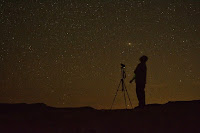 |
| Now get outside and look up! |


