Introduction
April was a great month for space news! The Artemis II crew launched on April 1st and returned on the 10th with great success. As far as stargazing, April was kind of mixed again for Utahns. We did experience some warm temperatures and clear nights, but also had a few rain and snow storms mixed with cold temperatures. As is typical in my experience, stormy weather occurs on the days that work best for my stargazing schedule. I'm hoping to finally catch a break during May!
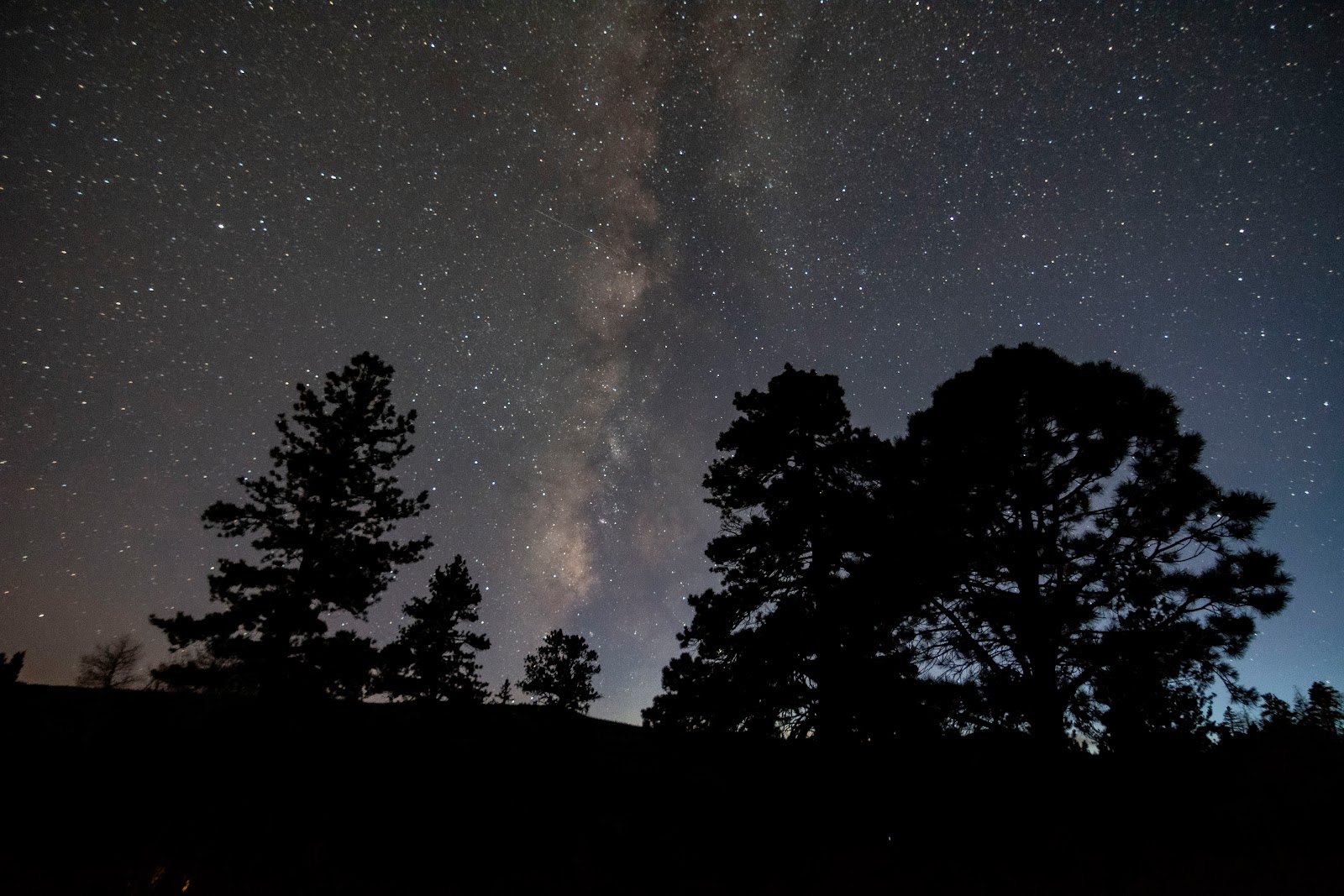
May should offer warmer temperatures and fewer storms than April over Utah. Obviously, the weather is going to do whatever it wants, when it wants, so before loading up and taking all of your astronomy gear to a dark sky location, check the weather! May will experience a "Blue Moon" or two full moons in a single month. The Eta Aquariids Meteor Shower will peak this month. Jupiter and Venus won't quite experience a planetary conjunction this month, but they are moving ever closer to one another in our night sky. May also begins the season of the Milky Way Bands' core marching across the night sky. It will rise shortly after midnight during the first week of the month and will rise earlier with each passing night.
 |
| Mercury |
Mercury will transition from being found in the morning sky before sunrise to being visible shortly after sunset. This tiny world will be difficult to spot against the Sun's morning glow during the first half of the month. It will reach solar conjunction on the 14th, passing behind the Sun as seen from Earth. As it emerges from behind the Sun, Mercury will transition to an evening object on the western horizon. The best chance to see Mercury will come at the end of the month when it lies furthest from the Sun during the month of May. It will continue to pull away from the Sun during the early part of June.
 |
| Venus |
Venus will remain easy to find in the evening sky after sunset throughout May. It is the third brightest natural object in the sky, only to be outshone by the Sun and the Moon. As the days fly by in May, Venus will be found rising higher above the western horizon if it's viewed at the same time after sunset each evening. A very thin crescent Moon can be seen close by on the 18th. Venus starts May residing among the stars of Taurus, but by the end of the month, this bright planet will be found in Gemini with Jupiter. Stay tuned for their planetary conjunction next month!
 |
| Mars |
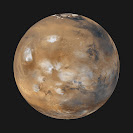
Mars can still be found rising above the eastern horizon shortly before the Sun during May. It averages approximately magnitude 1.25 during the month and will be hard to spot against the brightening morning sky. The best chance will come towards the end of the month when the Red Planet rises above the horizon approximately an hour before the Sun. Mars currently lies about 2.2 AU from the Earth, which is over twice as far as the Earth-Sun distance! This places the Red Planet on the far side of the Sun from our perspective, causing it to appear smaller and dimmer. Mars will be found in Pisces during May, with a thin crescent Moon joining this planet on the 14th.
 |
| Jupiter |
Saturn can be found in the early morning sky near Mars at the start of May. However, the Ringed World will fare better than Mars this month as it increases its distance from the Sun. The best time to view Saturn will be at or near the end of the month, when it rises about two hours earlier than the Sun. It can also be found in Pisces and will have the Moon as a companion on the 13th.
 |
| Neptune |
 |
| Uranus |
Uranus will be difficult to see in May. The two things that will make Uranus hard to see this month are its great distance from the Earth, which makes it quite dim, shining at magnitude 5.8, and its ever-decreasing proximity to the Sun from our Earth-bound view, which will cause this planet to be lost in the bright glow of the Sun. The best chance to see Uranus will come early in the month when it is highest above the western horizon, which is really only a few degrees at 9:15 on the first evening of May. By midmonth, Uranus will reach solar conjunction and will be visible in the morning sky in June.
Neptune wants to be seen! Unfortunately, this distant planet will be hard to see during May as it rises just a couple of hours before the Sun. Saturn rises shortly after Neptune, so if an observer can see Saturn in the early morning sky, use it as a guide to find Neptune, which is just a few degrees to the upper right (southeast) of the ringed world. Neptune will be easiest to spot as we move towards the end of May. This gives this ice giant time to clear the eastern horizon well before the Sun's glow starts to invade the inky blackness of the night sky. Neptune can be found among the stars of Pisces with a thin crescent Moon joining it on the 13th. On this date, the Moon will be nestled nicely between Saturn and Neptune.
Eta Aquariids, Moon, and Comet Tempel 2
The Eta Aquariid Meteor Shower will return this month. This shower is active between April 19th and May 28th, with the peak date falling on the morning of May 6th. During a good year, northern hemisphere observers can expect to see between 10 and 30 meteors per hour. Unfortunately, this year, a waning gibbous Moon will interfere, limiting this number to fewer than 10 meteors per hour. Observers should not be discouraged, as this is a good time to practice their meteor observing skills and find the best gear that suits each individual's needs for a comfortable night of meteor spotting. Aquarius, the apparent radiant of the Eta Aquariids, will begin to rise above the eastern horizon around 3:30 for Utahns.
May offers two Full Moon phases this month! The second Full Moon of the month, any month, is called a "Blue Moon." May will see a Full Moon on the 1st and 31st this month. I personally prefer to observe the Moon when it is not fully illuminated by sunlight, but I have yet to capture an image of the Full Moon with my smart telescope. This month I will get two opportunities! This month's Blue Moon will be considered a "Micro Moon," meaning it will appear slightly smaller than the average Full Moon, as compared to a Super Moon, which appears slightly larger than the average Full Moon.
Finally, we have Comet 10P/Tempel, more commonly known as Tempel 2. This comet is slowly brightening in the early morning sky and will be visible throughout the summer. On the 8th, Tempel 2 can be found near Aquila, the constellation that contains the bright star Altair, which rises above the eastern horizon around midnight. Observers who are able to stay out all night should try to catch Tempel 2 before the Moon rises at 2:30 AM. As mentioned in the introduction, the Milky Way Core will be rising above the horizon close to this same time. In fact, Tempel 2 can be found just below the Milky Way Band on the 8th, but will move farther away and closer to the horizon as the month continues. Tempel 2 will also brighten as the month progresses, making it easier to spot in the predawn sky.
Monthly Breakdown
May 01: Full Moon 🌕
May 06: Eta Aquariid Meteor Shower peaks
May 10: Last Quarter Moon🌗
May 17: New Moon 🌑
May 23: First Quarter Moon 🌓 May 31: Full Moon 🌕 Blue Moon
 |
| Now get outside and look up! |
Planet images were taken by NASA.
Andrew vs. the Cosmos image was taken by Jeff Greenland.The Milky Way and Trees image was taken by Andrew Greenland.
Orion, Taurus, and Pleiades image was taken by Andrew Greenland.




No comments:
Post a Comment