Tuesday, December 30, 2025

Monthly Night Sky Report: January 2026

                  Introduction

   December 2025 remained warm, with record high temperatures tied or set throughout the month. I witnessed several spectacular sunrises and sunsets, Starlink flying high overhead, and, of course, the bright planets and constellations. We also finally received some snow, mostly at higher elevations.

   The highlights of January are sparse, but still notable for interested observers. The Winter Constellations, like Orion, Taurus, and Gemini, will continue to float overhead. The Quadrantid Meteor Shower will peak this month. Saturn will be visible with its mesmerizing rings, and Jupiter will reach opposition, shining brightly throughout the month. The first Super Moon of 2026 will occur during the Full Moon phase this month. Unfortunately, the inner rocky planets will be difficult, if even possible, to spot during January.    


Mercury


   The observing window for Mercury is short during January. The best chance to catch the innermost planet will come during the first morning of the year before sunrise. Mercury will rise about 30 minutes before the Sun and shine at -0.5 magnitude. This tiny world will be less than 5° above the horizon before the Sun's glow overpowers it. An observer will need to have a clear view of the eastern horizon before sunrise for a chance to see Mercury. As the month continues, Mercury will move closer to the Sun until its conjunction on the 21st. This planet will return to the evening sky in February. 

  
Venus

   Last month, Venus was lost from view as it approached the Sun from our vantage point. This month will also be a Venus-free month as this world reaches conjunction on the 6th and hugs the Sun. If an observer can get to a high elevation and have a clear view of the western horizon, there is a slim chance of spotting this planet after sunset and before it dips below the horizon on the final evening of January. Venus will make its presence known in February.  
    
Mars
    
   Mars reaches conjunction with the Sun on the 9th and will not return to our skies until spring.


Jupiter
Saturn


   Jupiter will likely be the highlight of the night sky over the next few months. This giant world will reach opposition on the 10th, making it visible nearly all night. It will easily outshine all other natural objects in the night sky, except the Moon. The stars of Gemini will paint the backdrop for Jupiter. As always, several Galilean Moon transits can be observed throughout the month. I encourage interested observers to use the Moons of Jupiter and Saturn app for Android or Gas Giants for iOS devices to determine when these transits occur at their location. Both of these apps are free. If an observer is interested in a paid, more comprehensive app, I recommend Stellarium Plus for Android and iOS, as well as SkySafari Pro for iOS. The Earth's own Moon will pass close by Jupiter on the 3rd and 30th this month.  

   Observers should view Saturn as they wait for Jupiter to climb high in the sky. The rings are still nearly edge-on but are still visible through a small telescope. If using a low-power eyepiece, an observer can also see Neptune in the same field of view. The pair will move closer together as the month marches on. These two planets will start the month with 3.5° of separation but will close the gap to less than 2° by the month's end. As mentioned in previous posts, Moons of Jupiter and Saturn, Gas Giants, Stellarium Plus, and SkySafari Pro are great tools for identifying Moon transits, among other things, in the night sky. The Earth's own moon will pass close to Saturn on the 23rd.


Neptune
Uranus


   January 2026 will be the best time to view Uranus until the end of the year. This ice giant will be high above the horizon after sunset and can be found just below the Pleiades, an easy-to-spot object in the night sky. While using a pair of binoculars or a telescope to view the Seven Sisters, let the optical aid drop slightly to find this planet. It will appear as a greenish disk against the background stars of Taurus. The Earth's Moon will pass close by on the 27th.

   Neptune will be easy to spot by targeting Saturn with binoculars or a telescope this month. This distant world will share a field of view with the ringed planet. The pair will start the month off being just 3.5° apart but will move closer together, ending the month at just 1.5° of separation. The Earth's Moon will pass close by on the 23rd.


Quadrantid Meteor Shower

   The Quadrantid Meteor Shower will peak on the 3rd of this month. Typically, this shower is spectacular and is known for producing fireballs. Unfortunately, this year the Quadrantids peak under a Full Moon, reducing the maximum rate from 80 to about 12 meteors per hour. This is a bad start for meteor watchers of 2026! However, observers should not be entirely discouraged, as the fireballs that are often visible during this shower will still be visible during the Full Moon. Interested observers should look towards BoΓΆtes as soon as it rises above the horizon on the 3rd. For Utahns, this will occur between 1:30 and 2:00 AM.


Monthly Breakdown


January 03: Full Moon πŸŒ•
January 03: Moon passes within 4° of Jupiter
January 03: Quadrantid Meteor Shower peaks
January 06: Venus reaches superior conjunction with the Sun
January 09: Mars in conjunction with the Sun
January 10: Jupiter reaches opposition 
January 10: Last Quarter MoonπŸŒ— 
January 18: New Moon πŸŒ‘
January 21: Mercury reaches superior conjunction with the Sun
January 23: Moon passes within 4° of Saturn
January 23: Moon passes within 4° of Neptune 
January 25: First Quarter Moon πŸŒ“ 
January 27: Moon passes within 5° of Uranus
January 30: Moon passes within 4° of Jupiter 


Now get outside and look up!
Planet images were taken by NASA.
Andrew vs. the Cosmos image was taken by Jeff Greenland.
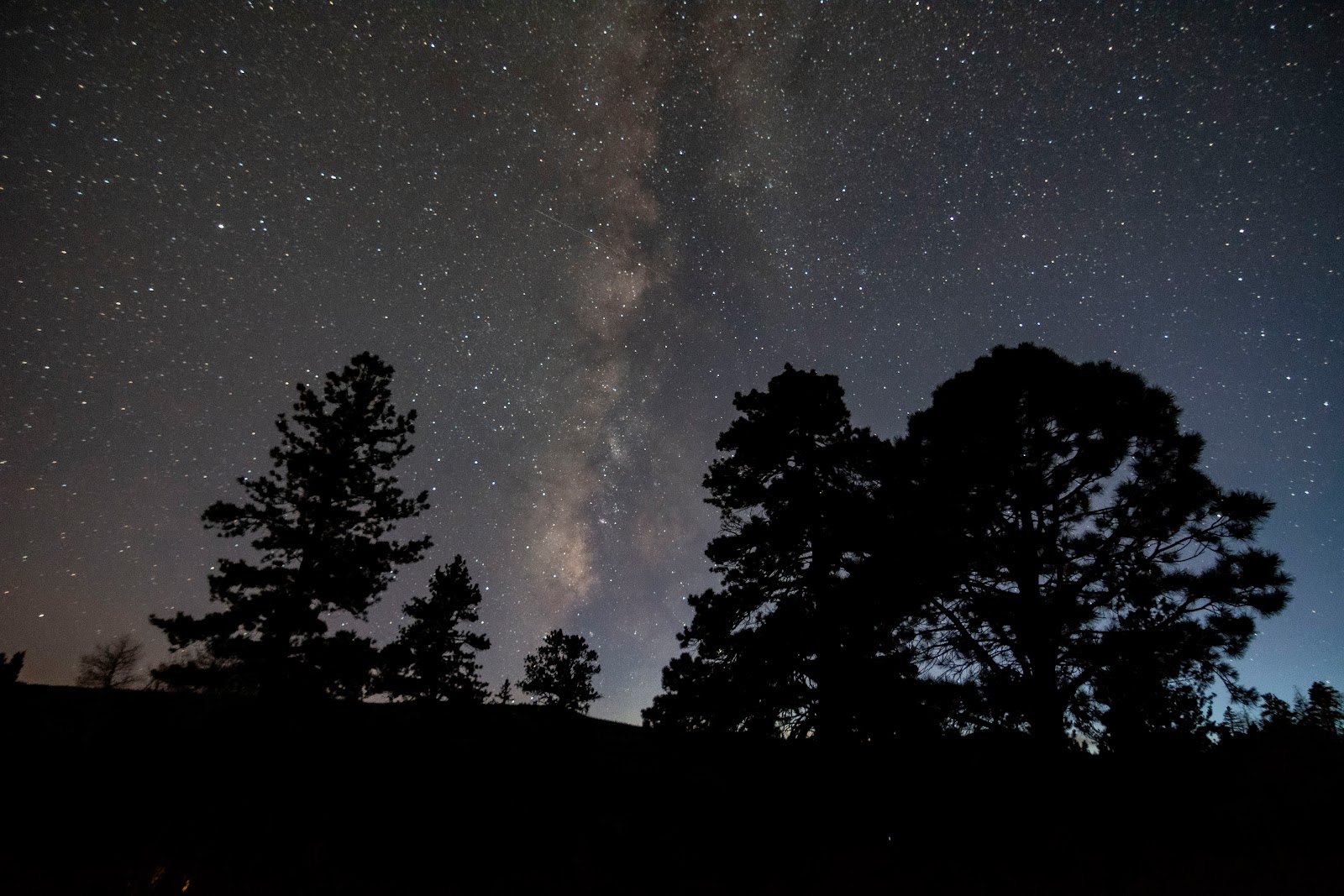
The Milky Way and Trees image was taken by Andrew Greenland.
Orion, Taurus, and Pleiades image was taken by Andrew Greenland.


Sunday, December 14, 2025

Midmonth Check-In: December 2025 and Events of 2026


  Introduction and Monthly Reminders   

     This December has been unusually warm in Utah, giving stargazers of all kinds the chance to enjoy the night sky. I have relished viewing Jupiter, Saturn, and the Moon with my unaided eyes, and of course, my favorite winter constellations. I missed the occultation of the Pleiades by the Moon due to cloudy weather, as well as the Geminid Meteor Shower. I am hopeful for the clear nights to continue so I can enjoy the night sky for the remainder of the year. 

    The Winter Solstice is fast approaching, meaning the length of the night will begin to decrease. This occurs on the 21st. The following night, the Ursid Meteor Shower will peak, bringing the chance to see approximately 15 meteors per hour. The Moon will not interfere with this shower. Observers should bundle up and look towards Polaris for their chance to spot as many meteors as possible. 


Upcoming Events of 2026 

      This past year has brought many incredible sights to the night sky. Jupiter and Saturn reached opposition, giving observers fantastic views of these gas giants. Saturn's rings were tilted so that they appeared edge-on for Earthbound observers. This will continue over the next several months, so if an observer missed it during 2025, they will still have the opportunity in 2026. Several comets graced our night sky, including an interstellar comet that is still passing through our solar system. 

    The upcoming year will bring many more exciting and spectacular events for observers to enjoy and look forward to. Of course, the planets will all be visible, with Mercury oscillating between the evening and predawn sky. Venus will dominate the evening sky beginning in February and continuing through September. It will then return to the morning sky in November and remain there through the end of the year. Mars will be a great target near the end of 2026 when it shines at nearly -0.3 magnitude. While the Red Planet won't be at its best, it may still offer some surface details to telescope observers in December. 

    Jupiter will reach opposition in January and be at its best in early 2026. This King of the Planets will remain a great target throughout the year, except during its solar conjunction in July. Even a small telescope or binoculars will reveal the large Galilean Moons. Saturn will be a spectacular target for 10 of the 12 months of 2026. The exception will be March and April, when the Ringed World will go through solar conjunction. A small telescope will reveal the rings and even the largest of its moons.

    Uranus will be visible during much of 2026. This ice giant will be found in the evening sky during the first four months of the year. It will then be lost in the Sun's glow during its solar conjunction in May and most of June. It will then reappear in the morning sky in July and eventually return to the evening sky. Neptune will stay close to Saturn during the first four months of 2026 until it passes the Ringed World and rises earlier. It can be found in the morning sky beginning in April, but it will be difficult to spot until May. 

    Utahns will be treated to a Total Lunar Eclipse during March and a Partial Lunar Eclipse in August. For those able and willing to travel, there will be an Annular Solar Eclipse in February and a Total Solar Eclipse in August. 

    There are a few great meteor showers this year that will peak under Moon-free or nearly Moon-free skies. The first will be the Lyrids in April during the First Quarter Moon Phase. The much-anticipated Perseids will peak in August during a New Moon. The Perfect time for a meteor shower! Finally, the Geminids in December will peak during the First Quarter Moon Phase, allowing observers to catch up to 150 meteors per hour!

    Comets are unpredictable but often grace our night sky with their long tails. Hopefully, 2026 will bring some bright comets and perhaps even one bright enough to see with the unaided eye! The Sun reached solar maximum in 2025 but still remains very active. Like comets, the Sun can be unpredictable and may result in the Northern Lights appearing over Utah again.

    Enjoy 2026 and don't forget to look up!      


Now get outside and look up!