Introduction
November has been unusually warm this year in Utah. Typically, we have snow by now, but that hasn't happened this year. As I write this, the weather forecast says snow is on the horizon, but I've heard that before. As much as I enjoy the mostly clear skies for stargazing, I also enjoy having snow during the winter months! During the last half of November, I have enjoyed gazing at the gas giants, Jupiter and Saturn, as well as the winter constellations, with Orion being my favorite.
In addition to the gas giants and wonderful winter constellations, December will bring the return of the Geminid Meteor Shower, one of the best of the year. This month, the Winter Solstice occurs, marking the start of longer hours of daylight. During one special night for Utahns, the Pleiades will disappear from view!
 |
| Mercury |
Mercury will be at its best this month for Northern Hemisphere observers. This tiny planet will be visible in the morning sky throughout December. Mercury will rise about an hour before the Sun on the 1st, giving observers some time to find it. It will reach its greatest western elongation on the 7th, shining at magnitude -0.4. On the 17th, the thin Crescent Moon will join Mercury in the morning sky. Arcturus and Spica can be found rising above the horizon before Mercury. On the 22nd, Antares can be seen rising with Mercury, but the pair may be a challenge to spot in the morning twilight.
 |
| Venus |
Venus is approaching the Sun from our vantage point and will be lost from view during December. This hot planet will return in January.
 |
| Mars |
Mars, like Venus, is approaching the Sun from our vantage point and will be lost from view for the next couple of months. It will return to the morning sky in spring 2026.
 |
| Jupiter |
 |
| Saturn |
Saturn is a spectacular target during December. It is already high in the sky after sunset. This places the ringed planet in the best place in the sky to minimize light pollution and atmospheric interference. Although the rings are not at their maximum tilt from our perspective, they are still visible and quite remarkable to see nearly edge-on. Of course, I speak from experience. I was able to view this planet a short time ago through my new scope, and it certainly did not disappoint. The rings and a couple of its moons were easily visible. If the skies are clear, bundle up to view the gas giants! As mentioned in previous posts, Moons of Jupiter and Saturn, Gas Giants, Stellarium Plus, and SkySafari Pro are great tools for identifying Moon transits, among other things, in the night sky. The Earth's own moon will pass close to Saturn on the 26th.
 |
| Neptune |
 |
| Uranus |
Uranus will continue its reign over the stars of Taurus. This ice giant won't appear as bright as the major stars of this constellation, but when viewed through a telescope or binoculars, it will show a blue-green disk, unlike the stars. The Pleiades (M45) can be found just above this planet. The Earth's Moon will pass close by on the 3rd and 31st.
Neptune will follow Saturn in the night sky during December. The pair can be found roughly 4° apart throughout the month, with Neptune being to the upper left of Saturn after the Sun dips below the horizon. The Earth's Moon can be found close by on the 26th.
The Pleiades Disappear While Geminids Shine
Utahns are in for a treat this month! We will be ideally positioned to watch the Moon block the Pleiades from view. This special, unique opportunity will take place on the 3rd of this month. Beginning at 5:30 PM, the Moon will start to pass in front of the first star of M45. The Moon will continue to pass between M45 and the Earth, blocking more stars from view of this open star cluster. The entire event will last about four hours. No special equipment will be required; however, a pair of binoculars or a telescope with a low-power eyepiece will enhance the views.
The next major event during December will occur on the 14th. The Geminid Meteor Shower returns! While the Perseids are one of the favorite meteor showers of the year due to warmer weather, the Geminids produce more meteors per hour under ideal conditions. An observer will have to bundle up to enjoy the show, however. With up to 150 meteors per hour and the chance for several bright meteors, I encourage observers to get out and look up! There will be a last-quarter Moon in the sky, but it should only wash out the faintest meteors. The Geminids appear to radiate from Gemini, which will be high in the sky around midnight, making even more meteors visible.
The next major event during December will occur on the 14th. The Geminid Meteor Shower returns! While the Perseids are one of the favorite meteor showers of the year due to warmer weather, the Geminids produce more meteors per hour under ideal conditions. An observer will have to bundle up to enjoy the show, however. With up to 150 meteors per hour and the chance for several bright meteors, I encourage observers to get out and look up! There will be a last-quarter Moon in the sky, but it should only wash out the faintest meteors. The Geminids appear to radiate from Gemini, which will be high in the sky around midnight, making even more meteors visible.
December also brings the Ursid Meteor Shower. While this shower is not as prominent as the Geminids, producing only about 15 meteors per hour, it is still a great shower to watch, as the Moon will not interfere this year. The Ursids peak on the 22nd and will appear to radiate from Ursa Minor, or the Little Dipper. Observers will just have to look north towards Polaris to watch this shower.
The Winter Solstice will occur on the 21st this month. This day marks the time in Earth's orbit when the planet's tilt will give the Northern Hemisphere longer daylight hours. I know this is one of my co-workers' favorite times of the year. As an astronomer, I prefer the longer nighttime hours!
 |
Monthly Breakdown
December 03: Moon passes within 5° of Uranus
December 03: Moon blocks M45 from view
December 04: Full Moon 🌕
December 07: Moon passes within 4° of Jupiter
December 07: Mercury reaches its greatest western elongation
December 11: Last Quarter Moon🌗
December 14: Geminid Meteor Shower peaks
December 18: Moon passes within 6° of Mercury
December 19: New Moon 🌑
December 21: Mercury reaches inferior conjunction with the Sun
December 22: Ursid Meteor Shower peaks
December 26: Moon passes within 4° of SaturnDecember 27: Moon passes within 3° of NeptuneDecember 27: First Quarter Moon 🌓December 31: Moon passes within 5° of Uranus
 |
| Now get outside and look up! |
Planet images were taken by NASA.
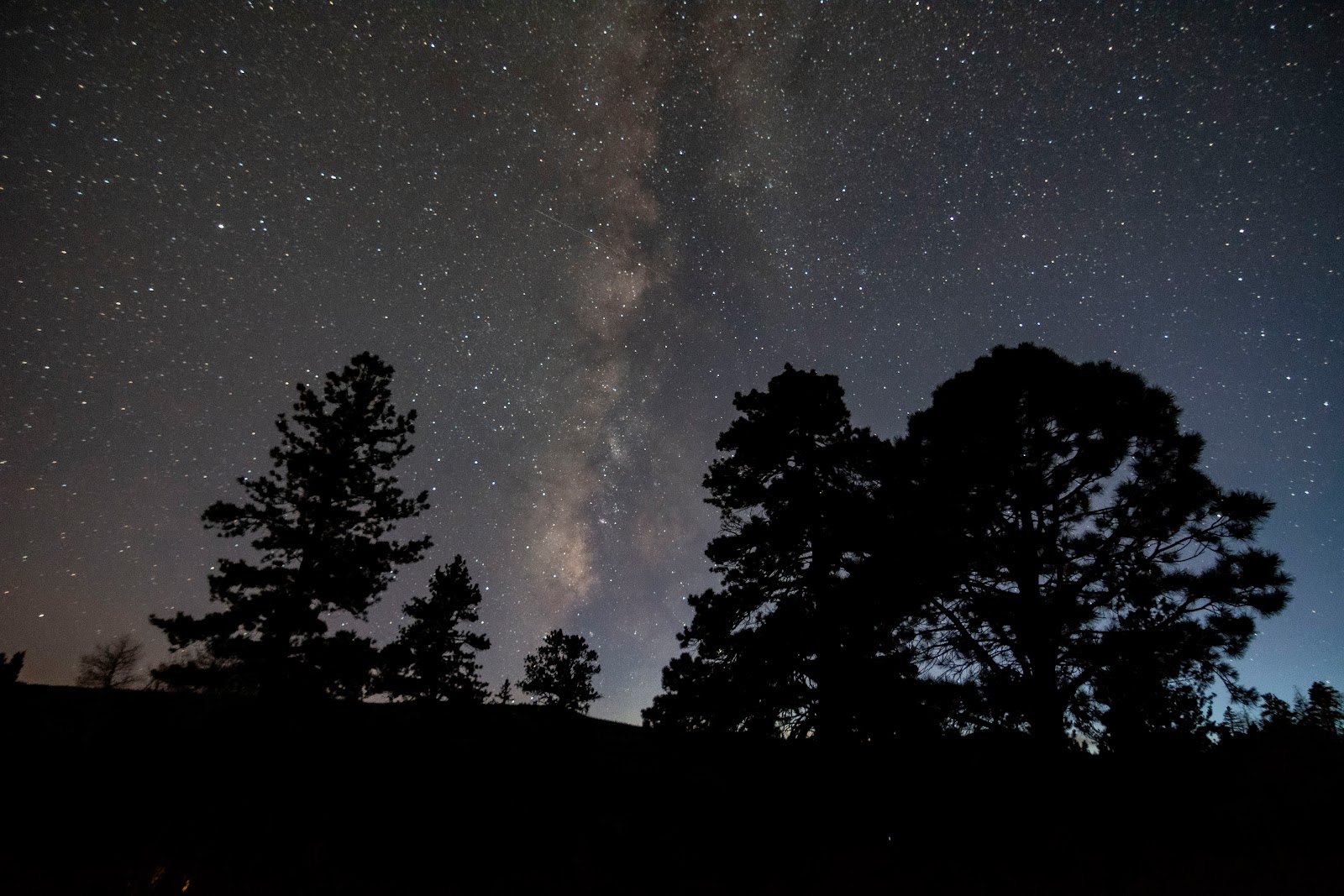
Andrew vs. the Cosmos image was taken by Jeff Greenland.The Milky Way and Trees image was taken by Andrew Greenland.
Orion, Taurus, and Pleiades image was taken by Andrew Greenland.

No comments:
Post a Comment