Introduction
August was still warm, with a few cooler, rainy days mixed in. Utahns experienced some evening thunderstorms, reminiscent of the summer storms I remember as a kid. I saw a few Perseid meteors and took one of my scopes out to view the stars. I also saw part of the Partial Lunar Eclipse before the clouds rolled in.
September should offer some great nights of stargazing. Cooler temperatures bring a steadier atmosphere and let observers use high-powered eyepieces to better reveal the details of the Moon, planets, and deep-sky objects. This month will be a less exciting month for stargazers, with no major meteor showers and no eclipses. Neptune will reach opposition during September, making it the best time of the year to view the most distant planet in our solar system.
 |
| Mercury |
Mercury will be a difficult target for Northern Hemisphere observers in September. The ecliptic brings Mercury close to the horizon, so a high, clear view of the western sky will be needed shortly after sunset. The best chance to see this tiny world will come on the 12th when the Moon is just 11° away. Venus will also be nearby.
 |
| Venus |
Venus will be easy to spot after sunset, even before the glow of the Sun retreats from the evening sky. This world will sink below the western horizon earlier with each passing day, but it will remain prominent in the sky. Venus will reach its greatest illumination on the 18th, shining brightly at -4.8 magnitude. Observers with binoculars or a telescope can see the planet's different phases, with about 25% of its disk illuminated on the 21st.
 |
| Mars |
Mars can be found rising with the stars of Gemini in early September, around 2:30 AM. By the end of the month, the Red Planet will have crossed into Cancer, the Crab, and rise approximately an hour earlier. This outer rocky world will not offer much detail through a telescope because of its distance from Earth, but better views will present themselves in early 2027.
 |
| Jupiter |
 |
| Saturn |
It is nearly peak Saturn observation time as it approaches opposition in October. For the time being, the Ringed World can be found rising above the eastern horizon around 10:30 PM at the start of the month and by approximately 8:30 PM by month's end. A telescope will reveal Saturn's ring structure and its largest moons. You can observe several moon transits this month. I recommend using the Moons of Jupiter & Saturn app to find when these transits will occur at your location.
 |
| Neptune |
 |
| Uranus |
Uranus can be found hiding among the stars of Taurus. This distant world is about halfway between the Pleiades and the Hyades star clusters throughout September. While technically visible to the unaided eye from a dark, Moon-free sky, binoculars or a telescope will help you distinguish it from the background stars.
Neptune reaches opposition on the 25th, making this date one of the best times of the year to view this most distant world. Neptune can be found rising with Saturn and the stars of Pisces. You will need binoculars or a telescope to see this world.
Deep Sky Objects
This September, there aren't many exciting astronomy targets to view. However, plenty of DSOs are visible with a telescope. Observers may also catch up to seven meteors per hour during any night of the month, although the best time to view will come during the New Moon phase. I recommend bringing a comfortable chair and warm clothing to a dark-sky site, relaxing, and looking up at the wonders of our night sky.
 |
Monthly Breakdown
September 03: Moon passes within 5° of UranusSeptember 04: Last Quarter Moon🌗September 06: Moon passes within 3° of MarsSeptember 08: Moon passes within 1° of JupiterSeptember 10: New Moon 🌑September 14: Moon passes within 1° of VenusSeptember 18: First Quarter Moon 🌓September 22: Autumnal EquinoxSeptember 25: Neptune reaches oppositionSeptember 26: Full Moon 🌕September 26: Moon passes within 5° of NeptuneSeptember 27: Moon passes within 7° of SaturnSeptember 30: Moon passes within 5° of Uranus
 |
| Now get outside and look up! |
Planet images were taken by NASA.
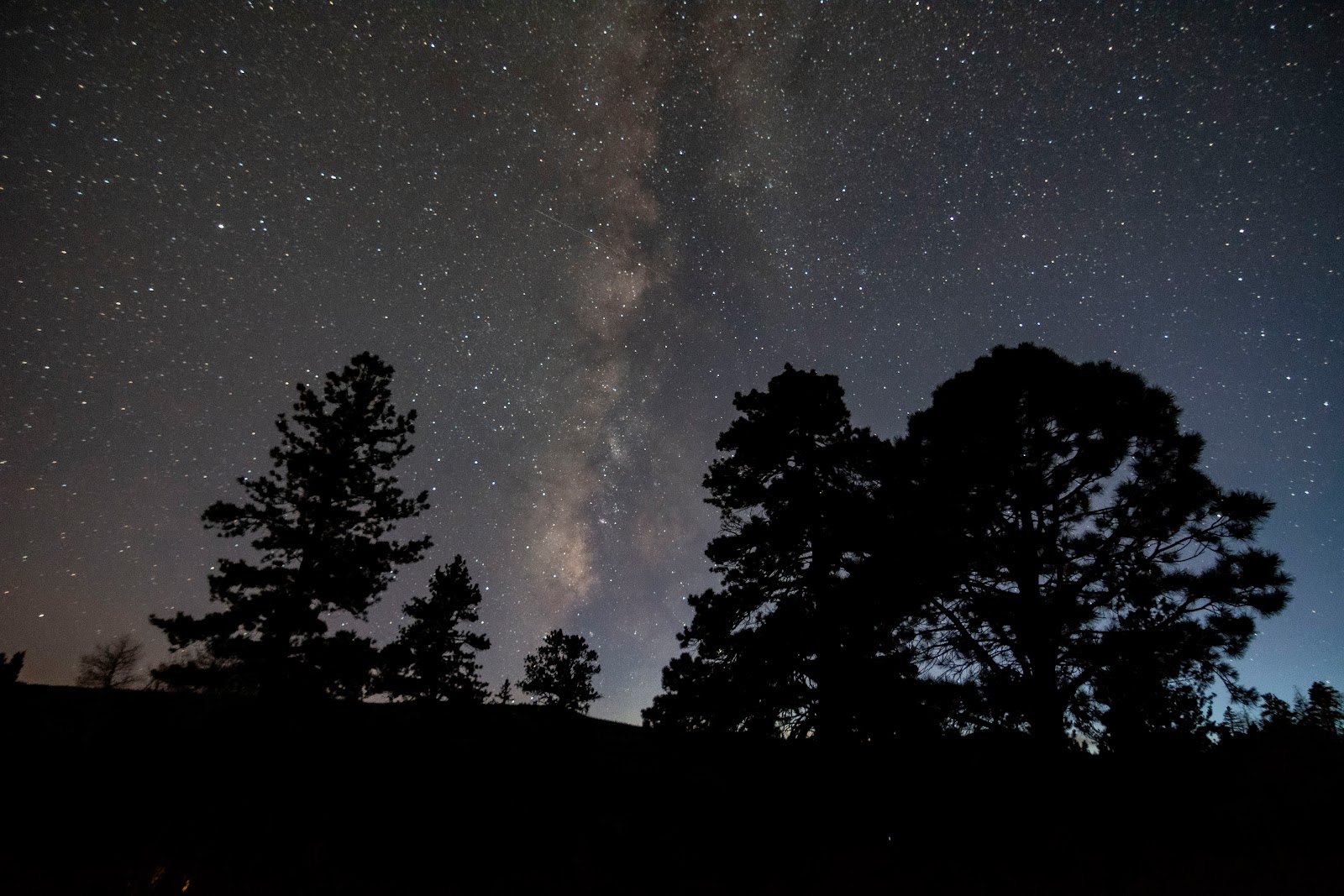
Andrew vs. the Cosmos image was taken by Jeff Greenland.The Milky Way and Trees image was taken by Andrew Greenland.
Orion, Taurus, and Pleiades image was taken by Andrew Greenland.

No comments:
Post a Comment