Sunday, March 15, 2026

Midmonth Check-In: March 2026 and Music & Astronomy


  Introduction and Monthly Reminders   

     The weather so far this March has been off the rails! Utah started the month off with a few major rain and snowstorms, blocking the Total Lunar Eclipse on the 3rd from view, of course. I was hoping for clear skies, but wasn't surprised by the timing of the storms and cloud cover. After the storms, the temperatures shot up to 60°+ for the daily high with many clear nights. 

    I'm hoping that the clear weather and mild temperatures continue so that I, and all other stargazers, can enjoy the night sky. I am anxious to get my telescopes back out under the stars where they belong! Observers can still count on seeing many of the DSOs from the Messier Catalog during the remainder of March. The New Moon phase is quickly approaching, making it a great time to view these faint fuzzies. During the New Moon phase, the Zodiacal Light will be easy to spot in the west after sunset. A camera capable of taking long-exposure images will also be beneficial.  


Music and Astronomy

    I have always had a great love of music and almost constantly have something playing. Even now, as I write this post, I have my Stargazing Ambient playlist on in the background. Perhaps some of my readers will find it surprising that astronomy and music are connected. I'm not talking about musicians writing songs with astronomy-related lyrics, like Space Oddity by David Bowie, or music written with the heavens in mind, like The Planets by Gustav Holst, or even astronomers being popular musicians like Brian May, an astrophysicist who is also a member of Queen. I'm talking about how music and astronomy are both based on vibrations and waves.

    Sounds are created by vibrations in the air that the ear can pick up. These vibrations can be caused by any number of things, a few of which could be from me attempting to play a song on a guitar, the sound of my telescope eyepiece hitting the ground when I drop it, and the choice, usually explicit, words that come out of my mouth when this happens. All of these vibrations are just sound waves traveling through the air at frequencies measured in Hertz (Hz) that the human ear can detect. Frequency determines the sound we hear. A high frequency is a higher-pitched, shrill sound, like a siren or whistle. A low-frequency, low-pitched sound could be, for example, thunder or a bass drum. It is important to note that the volume is not related to the frequency or pitch of a sound, regardless of how it sounds to the human ear. The low E string on my guitar, when tuned correctly, has a frequency of approximately 82.4 Hz. This frequency does not change, no matter how hard or soft I pluck the guitar string. Similarly, if I pluck the high E string, it produces a frequency of approximately 330 Hz, a much higher, shrill sound compared to the low E string. Again, this pitch does not change if I pluck the string hard or soft.     
    When studying the night sky, astronomers are looking at different light, radio, or gravitational waves, depending on the instrument, if any, that is used. Light waves, like sound waves, come in many different frequencies, with the human visible range between 380 and 750 nanometers (nm). The violet color corresponds to the lower end of the visible spectrum, 380 nm, while red corresponds to the high end at 750 nm. While observing the night sky, it's easy to see that stars have different colors, meaning they emit light at different wavelengths. For example, Aldebaran, the red star in Taurus, has a color wavelength of approximately 741 nm, while Procyon, the brightest star in Canis Minor, has a wavelength of approximately 440 nm, corresponding to a blue-violet color. Interesting fact: several of the brightest stars in the sky, such as Sirius, Rigel, and Vega, have peak wavelengths in the ultraviolet range, which is outside the visible spectrum for humans. However, because these stars produce so much light, some of it "leaks" into the visible spectrum for humans to see.

    Math is all around us, including in music and astronomy. In music, there is often harmony between the notes played on instruments and the sound of the singing voice. One simple example of harmony can be demonstrated using a single string on a guitar. It does not matter which string, but I will use the low E string as an example. As mentioned earlier, when in tune, the frequency of this string when plucked is 82.4 Hz. I can then press the 12th fret, which produces another E note, an octave higher, at 164.8 Hz. The 12th fret on most guitars essentially makes the string half as long, so it has a frequency, or pitch, twice as high, creating a 2:1 ratio. Since both of these are an E note, they are said to be in harmony. There are several other types of harmony, but I just wanted to demonstrate the octave.  

    Astronomy also offers examples of harmony amid chaos. The first example that comes to my mind is the three largest inner moons of Jupiter: Io, Europa, and Ganymede. For every four orbits Io completes, Europa completes two, and Ganymede completes one. This is known as an orbital resonance and can be expressed as a 4:2:1 ratio in this example. 

    In the past, I shared a link to different sounds in space, such as the sounds of the planets. Since space is a vacuum, how do we get these sounds? The sound of the planets was created by collecting electromagnetic, radio, and plasma-wave data and translating it into a frequency humans can hear. Some people find these sounds scary or creepy, but I find most of them quite relaxing. This is the best link I could find to demonstrate the sounds of our solar system; it even includes Pluto! Recently, images from space have also been converted to sound. While it's not the actual sound picked up from the cosmos, it is still quite fascinating. The process involves taking an image and converting the location, color, and brightness of each pixel into sound. For example, a star on the top of the image will have a higher note than a star on the bottom of an image. The brightness translates into a louder note, while the color could be a different instrument. Both of these techniques are called sonification. Here is the link to NASA's Sonifications page, which includes the sounds. They even let you create your own!            

    In review, music is patterns of sound frequencies, while astronomy is patterns of light frequencies. Both of these reveal that the universe is a deeply mathematical and rhythmic place! 

Artemis II Update: This spacecraft and four astronauts are expected to launch on April 1st, with the SLS returning to the launchpad around March 19th. The intended mission is to fly around the Moon before returning to Earth.    

    Show that you support dark skies by being one of the first Utahns to get a Dark Sky license plate! Visit Dark Sky Utah to apply for a new license plate for your vehicle. 


Now get outside and look up!
   

Saturday, February 28, 2026

Monthly Night Sky Report: March 2026

                    Introduction

   The last two weeks of February in Utah received some rain, snow, and colder temperatures, making stargazing difficult or impossible. Even with the cloud cover on most nights and mornings, I was still able to spot Jupiter, several of the winter constellations, and the Moon moving across the night sky. 

    March should prove to be a great month for stargazers, weather permitting, of course. The most notable events include a Total Lunar Eclipse, running the Messier Marathon, and the chance to see the Zodiacal Light. The Vernal (Spring) Equinox occurs this month as well. Saturn and Neptune will reach conjunction with the Sun and will be lost from view during most, if not all, of March.       

    Due to a few setbacks, the Artemis II mission has been delayed and is not expected to launch before April. The Space Launch System (SLS) has been rolled back to the Vehicle Assembly Building to address a few remaining issues, with a helium leak as the primary culprit. Stay up-to-date with the Artemis Mission here or with your favorite news source.


Mercury


   The innermost planet, Mercury, will hide from us Earthlings for most of March as it reaches inferior conjunction with the Sun on the 7th. The Moon will pass close by Mercury on the 17th, but this world will still be too close to the horizon to spot. But by the end of the month, Mercury will rise earlier and climb high enough to escape the morning glow of the Sun to be seen above the eastern horizon.    

  
Venus

   Venus will remain in the western sky after sunset during March. It will easily outshine all other objects in its region of sky except for the elusive thin Crescent Moon on the 19th and 20th. The Moon will be closer to Venus and 5% lit on the 20th. On the 7th and 8th, a dim Saturn can be found close to Venus. A pair of binoculars will help observers spot the Ringed World.  
    
Mars
    
   Mars can be found near Mercury but is still too close to the Sun in March, hiding its red glow from Earth.


Jupiter
Saturn


   Jupiter will remain a great target for the unaided eye, binoculars, or a telescope throughout March. It can easily be picked out among the stars of Gemini as it shines brightly at -2.3 magnitude on the first night of the month and dims by only 0.13 magnitude by the end of the month. Several of the Galilean Moon transits will occur this month, and many chances to see the Great Red Spot will present themselves. As the weather warms up this month, I encourage interested observers to use the Moons of Jupiter and Saturn app for Android or Gas Giants for iOS devices to determine when these transits occur at their location. Both of these apps are free. If an observer is interested in a paid, more comprehensive app, I recommend Stellarium Plus for Android and iOS, and SkySafari Pro for iOS. The Earth's own Moon will pass close by Jupiter on the 26th of this month.  

  Saturn will be difficult to spot during the month as it approaches the Sun. The best time to view the Ringed World is early in the month, with the 7th and 8th likely the best opportunities, as this planet lies close to Venus. A pair of binoculars will help reveal Saturn's faint glow. Saturn will reach conjunction with the Sun on the 25th.


Neptune
Uranus


   Uranus will continue to float near the Pleiades during March. Glowing dimly at approximately 5.7 magnitude, this ice giant is technically within range of being seen by the unaided human eye. A dark sky location and good visibility will be required to tackle this feat. My eyes aren't quite good enough anymore to see this planet without the aid of binoculars or a telescope. Through a telescope, Uranus will have a noticeable blue-green tint and will appear as a disk in the field of view instead of the pinpoint of a star, making it easy to tell if this planet is in the field of view. The Earth's Moon will pass close by on the 23rd.      

   Neptune, the outermost planet, will be difficult to spot during March. It can be found close to Saturn in the evening twilight after sunset. Neptune will require a clear view of the western horizon and a pair of binoculars or a telescope to see. It reaches solar conjunction on the 22nd but will return to our morning sky in the future.


Eclipse, Zodiacal Light, and Messier Marathon

       Comet Wierzchos is still visible in the early evening sky during March with optical aid. It can be found wandering through Cetus and Eridanus during the first two weeks of March as it approaches Taurus, and more specifically, Aldebaran, the red eye of the Bull. Comet Wierzchos will rapidly dim as it moves away from the Earth and returns to the outer solar system. 

    The Zodiacal Light will continue to be a sight to see during March. This month is a particularly great time to spot this ethereal glow as the Vernal (Spring) Equinox occurs. Anytime after the 8th will be great, as the Moon's glow won't affect the western horizon as much. Of course, the evenings surrounding the New Moon phase (March 18th) will be the ideal time to view the Zodiacal Light. No special equipment is required; however, a long exposure image will gather more light than the human eye can. Just point the camera to the west after the sky darkens! A wide-angle shot is usually preferable. 

    Utahns will be treated to a Total Lunar Eclipse in the early morning hours of March 3rd. This event will likely be the highlight for most observers this month. The eclipse will begin at 1:45 AM on the 3rd and will continue until the Moon sinks below the western horizon at approximately 7:00 AM. Totality will occur at 4:34 AM, so observers interested in only seeing the Blood Moon should set their alarms for this time! Weather permitting, I plan on setting up my smart telescope to capture the entire event. I have checked the weather several times, with some forecasts showing clear skies while others are predicting clouds and rain. At the very least, I would love to get an image of the Moon during totality. 

    March is the best time of the year for a Messier Marathon. The first weekend in March is the best time for Utahns, as most of the Messier Catalog will be above the horizon throughout the night. The only object that would be missed is M30, a globular cluster. Unfortunately, these dates coincide with the Full Moon Phase, further limiting the number of Messier objects that can be observed. During a good year when the dates coincide with a New Moon phase, observers typically spend only a short amount of time viewing the individual 110 objects of the Messier Catalog in order to fit them all in. By spreading this out throughout the year, an observer can spend considerably more time viewing each object. In recent years, with the advent of smart telescopes, observers have been attempting to image each object in a single night.      


Monthly Breakdown


March 03: Full Moon 🌕
March 03: Total Lunar Eclipse; Totality @ 4:34 AM 
March 07: Mercury reaches inferior conjunction
March 11: Last Quarter Moon🌗 
March 17: Moon passes within 2° of Mercury
March 17: Moon passes within 2° of Mars  
March 18: New Moon 🌑
March 20: Moon passes within 5° of Venus
March 20: Vernal (Spring) Equinox occurs 
March 22: Neptune reaches solar conjunction
March 23: Moon passes within 5° of Uranus 
March 25: Saturn reaches solar conjunction
March 25: First Quarter Moon ðŸŒ“ 
March 26: Moon passes within 4° of Jupiter 


Now get outside and look up!
Planet images were taken by NASA.
Andrew vs. the Cosmos image was taken by Jeff Greenland.
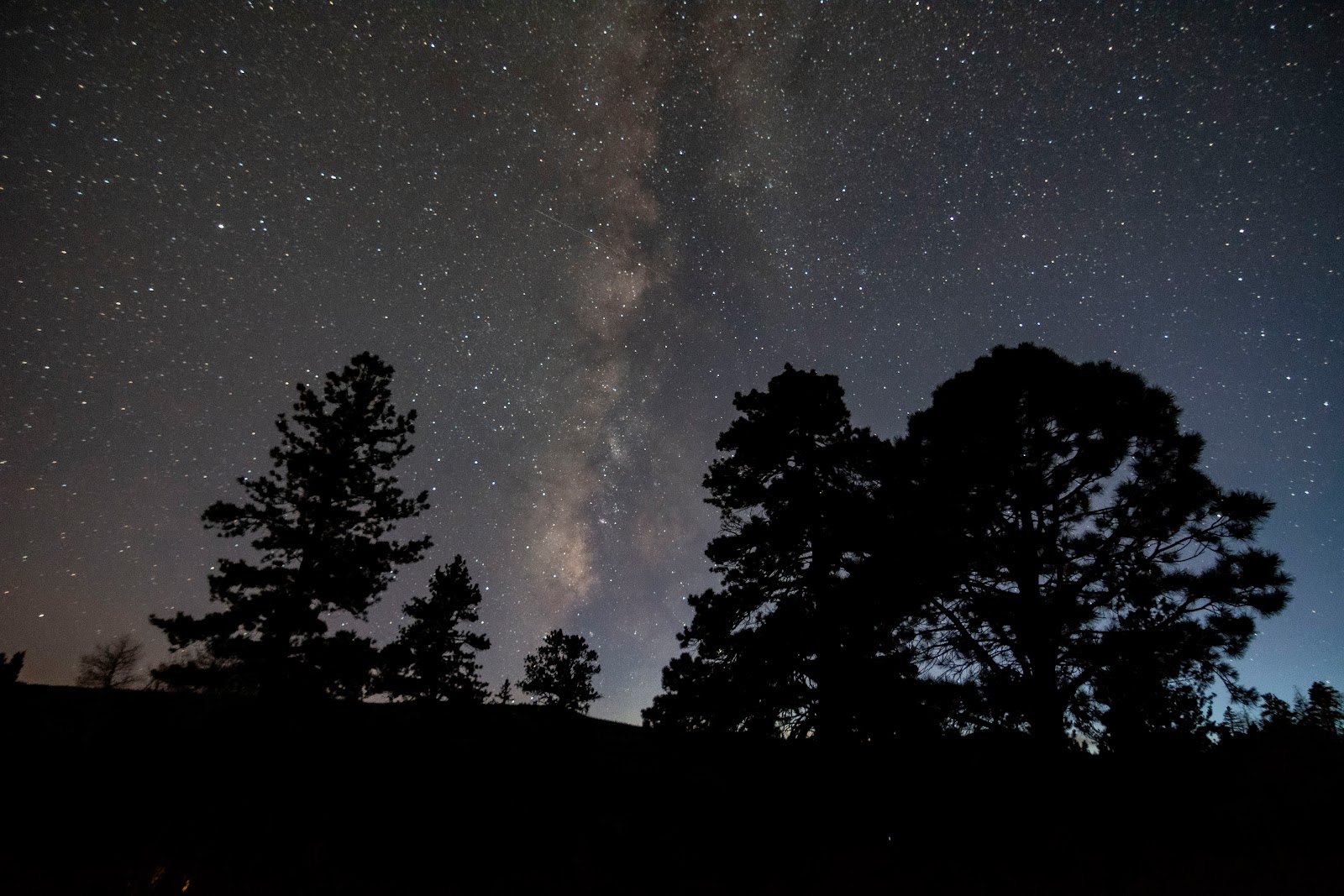
The Milky Way and Trees image was taken by Andrew Greenland.
Orion, Taurus, and Pleiades image was taken by Andrew Greenland.


Sunday, February 15, 2026

Midmonth Check-In: February 2026 and Utah's Dark Sky License Plate


  Introduction and Monthly Reminders   

     The unusual warm trend has continued in Utah through February. The state is known for its quality ski season, but this winter has produced low snowfall, and some ski resorts have had to temporarily shut down as they wait for a decent snowstorm. While the warmer temperatures have been welcome, I do prefer my winter season filled with snowstorms. On the flip side, as an astronomer, the lack of winter storms has been welcome, as long as the inversion stays away. While I have not taken out my larger telescopes to enjoy the night sky, I have used my small smart telescope, the ZWO Seestar S50, and my unaided eyes to satisfy my stargazing urges. I captured a few images of a major sunspot region on the Sun using the S50. I also enjoyed looking at Jupiter in Gemini, Orion, the Pleiades, and Taurus in the early night sky.  

    Still to come in February is the New Moon phase, which will allow astronomers to glimpse the fainter night sky objects and the Zodiacal Light. A dark-sky location will aid the observer's viewing experience. Comet Wierzchos will be climbing higher in the sky during the second half of February, making it easier to spot. Unfortunately, the comet will also dim as it gains altitude, requiring a telescope, binoculars, or a long-exposure photograph to see it. A dark sky location will also be a big help.     


Utah's Dark Sky License Plate

      Utah is home to the highest concentration of certified International Dark Sky Parks and Communities, not just in the United States, but in the entire world! Utah is also one of the world's premier destinations for astrotourism, a place where tourists go to view the stars because of its dark skies. Some national parks in Utah even offer ranger-led star talks to point out the constellations and tell their origin story. Several private companies in Utah also provide this experience and the use of their telescopes to enjoy the wonders of the night sky, for a price. As a testament to the quality of Utah's dark skies, nearly all the astrophotography images I have shared were taken in Utah, most within an hour or so of Salt Lake City. 

    In line with Utah's dark skies, the State is offering a way to show your support by getting a specialty license plate for your vehicle, trailer, or motorcycle. There is a small fee for the plate, which is the same as for any specialty or personalized license plate in Utah. Unfortunately, the state will only begin production after 500 or more orders have been placed. Visit Dark Sky Utah to apply for a new license plate for your vehicle to show that you support Utah's dark skies!    


Now get outside and look up!
   

Saturday, January 31, 2026

Monthly Night Sky Report: February 2026

                   Introduction

   January was a great month for viewing Jupiter, Saturn, and the winter constellations. The sky was mostly clear all month, but temperatures finally plummeted in Utah. The lack of storms allowed the Salt Lake Valley to fill with Utah's notorious inversion, where pollution from refineries and vehicles is trapped. The inversion limits visibility and prevents much planetary or DSO detail from coming through. The Sun was very active throughout January, giving Utahns a couple of chances to see the Northern Lights. Unfortunately, I was not one of the lucky ones to spot this nightly glow. 

    February will be another great month for viewing Jupiter, Saturn, and the winter constellations if the sky remains clear. Mercury and Venus will finally return to the darkened sky this month. If the Sun remains as active as it has been recently, there may be a chance for Utahns to catch the Northern Lights again. February doesn't bring a major meteor shower, but the Zodiacal Light will be visible on clear, Moon-free nights. All but one planet can be seen shortly after the Sun sets, with the 19th or later being the best opportunity. A comet may also be visible later in the month. 

    Artemis II has been moved to the launch pad and is expected to launch soon. This mission will send four astronauts around the Moon and return them safely to Earth. Artemis II is expected to launch before the end of March, but no earlier than February 8th. Stay up-to-date with the Artemis Mission and watch the launch live!


Mercury


   Mercury will be visible in the western sky shortly after sunset during February. The views improve as the month wears on, with the evenings surrounding the 19th being the best of the month. This tiny world will reach its greatest eastern elongation on this day, placing it approximately 20° above the horizon. A nearly New Moon will join Mercury on the 18th, with some lucky observers being able to watch the Moon occult Mercury. Unfortunately, that will not happen for Utahns.

  
Venus

   Venus will make its presence known during February. The Earth's evil twin sister will be found above the western horizon after sunset, with the best opportunities coming during the final 10 days of the month. A nearly New Moon will pass close by Venus on the 18th. If an observer is saving one day to view Mercury and Venus, the final day of February will find this pair of inner planets at approximately the same elevation above the horizon after sunset.  
    
Mars
    
   Mars is the only planet that observers will not be able to see this month. The Red Planet will return to our dark skies this spring.


Jupiter
Saturn


   Jupiter is easy to spot in the East as soon as the Sun sinks below the horizon. A pair of binoculars will easily reveal the four Galilean Moons, while a telescope can show off the cloud bands, the Great Red Spot, and surface shadows as the Galilean Moons transit this gas giant. Jupiter will remain nestled between the twins of Gemini. I encourage interested observers to use the Moons of Jupiter and Saturn app for Android or Gas Giants for iOS devices to determine when these transits occur at their location. Both of these apps are free. If an observer is interested in a paid, more comprehensive app, I recommend Stellarium Plus for Android and iOS, and SkySafari Pro for iOS. The Earth's own Moon will pass close by Jupiter on the 27th of this month.  

  Observers should target Saturn through a telescope in early February. It can be found in Pisces all month, standing approximately 30° above the western horizon after sunset on the first evening of February. Saturn is quickly approaching the Sun, limiting the amount of time and its altitude before the Sun's glare overtakes it. Neptune can be found just above Saturn on the 1st, but it will move to the same altitude as Saturn on the 24th. The best chance to view this pair of planets comes on the 15th when they are less than 1° apart, both planets fitting in a single field of view when using a low-power eyepiece in a telescope. As mentioned in previous posts, Moons of Jupiter and Saturn, Gas Giants, Stellarium Plus, and SkySafari Pro are great tools for identifying Moon transits, among other things, in the night sky. The Earth's own moon will pass close to Saturn on the 19th.


Neptune
Uranus


   Uranus will float next to the Pleiades in Taurus all month. A pair of binoculars or a telescope will reveal its greenish glow. The Earth's Moon will pass close by on the 23rd.   

   Neptune can be found hovering near Saturn all month. Its position will change from being above the Ringed Planet to moving to its right before it falls below Saturn. The best time to view Neptune this month will be during the first two weeks. After this time, Neptune's dim glow may be lost in the glare of the sunset. The Earth's Moon will pass close by on the 19th.


Northern and Zodiacal Lights and a Comet

    The Sun was very active during January, and this trend may continue through February and beyond. An active Sun increases the chance of seeing the Northern Lights, even for those farther south, like Utahns! January offered a couple of such chances to see the Northern Lights around midmonth. Unfortunately, I missed them, but I know others saw them! I recommend paying attention to your favorite news source to stay up to date on opportunities to see the Northern Lights.

    The Earth is at a point in its orbit around the Sun for its inhabitants in the Northern Hemisphere to see the faint glow of the Zodiacal Light. The best time to see this light will come after February 6th, when the bright Moon will be out of the evening sky. Interested observers should travel to a dark sky location and look west after sunset. After the Sun's glow fades, a cone of light will become visible, often shining about as bright as the Milky Way Band if the sky is truly dark. A long exposure photograph will help bring out the Zodiacal Light.

    February also brings the chance to spot a comet! Comet Wierzchos, discovered in March of 2024, will be visible for Northern Hemisphere observers during February. Comet Wierzchos won't be visible for Utahns until about mid-February, when it can be found above the southwest horizon on the 15th. As the month continues, Comet Wierzchos will gain altitude while also dimming in brightness. A pair of binoculars or a telescope will be required to see this comet. A dark sky site will also help in revealing its tail and color. On the 2nd, Saturn and Comet Wierzchos will be about the same altitude above the horizon at 7:30 Utah time, with the comet being further south (to the left) of Saturn.     


Monthly Breakdown


February 01: Full Moon 🌕
February 09: Last Quarter Moon🌗 
February 15: Saturn and Neptune within 1° 
February 17: New Moon 🌑
February 18: Moon passes within 2° of Venus
February 18: Moon passes within 0.1° of Mercury
February 19: Mercury reaches greatest eastern elongation 
February 19: Moon passes within 4° of Neptune 
February 19: Moon passes within 5° of Saturn
February 23: Moon passes within 6° of Uranus 
February 24: First Quarter Moon ðŸŒ“ 
February 26: Mercury and Venus within 5°
February 27: Moon passes within 4° of Jupiter 


Now get outside and look up!
Planet images were taken by NASA.
Andrew vs. the Cosmos image was taken by Jeff Greenland.
The Milky Way and Trees image was taken by Andrew Greenland.
Orion, Taurus, and Pleiades image was taken by Andrew Greenland.


Wednesday, January 14, 2026

Midmonth Check-In: January 2026 and Upcoming Missions


  Introduction and Monthly Reminders   

     January started off cold and wet, but now at midmonth, it's just cold! The Wasatch Front in Utah is experiencing its dreaded inversion, where warm air traps the cold, pollution-filled air in the valley below it. Visibility is limited, and air quality is horrible, with Utah sometimes ranking among the worst in the world during this time. Of course, this is bad for people with breathing conditions such as asthma or pneumonia. The limited visibility affects astronomy. It's like looking through a thin sheet of clouds. Despite these conditions, I have been able to see Jupiter shining brightly in Gemini, the stars of Orion, and the Moon. 

    The current weather forecast for Utah shows no storms, indicating the inversion will persist over the next week or two. Stargazers should still look up to see the bright points of light shining through the inversion. The conditions are less than ideal, but a telescope will still be able to show details on the Moon's surface, Saturn's rings, the Galilean Moons of Jupiter, and perhaps even Jupiter's cloud bands.    


Current and Upcoming Missions

      This year should be an exciting one for Space Missions. In 2025, the Vera C. Rubin Observatory, named after the astronomer Vera C. Rubin, who studied the rotation of galaxies and helped discover dark matter, began operations in Chile. This observatory will conduct a 10-year survey of the southern hemisphere's sky, averaging 1000 images per night. Its main science goals include understanding dark matter and dark energy, mapping our Milky Way galaxy, discovering and characterizing small bodies in our solar system, and discovering and tracking exoplanets. The Vera C. Rubin Observatory should make many new and exciting discoveries in the coming months and years! 

    There are two separate missions bound for Mars. The first is NASA's ESCAPADE mission, which launched in 2025 but will use Earth as a gravity assist in late 2026 to get the rest of the way to Mars. This mission is intended to study atmospheric loss on the Red Planet. The MMX mission from Japan is scheduled to launch in late 2026 and will study the moons of Mars.

    Several missions are heading towards the Moon in 2026. There will be two missions to the Lunar south pole, one from China and one from NASA, to study the resource potential of this area. NASA and ESA have a mission scheduled to launch late in 2026 that will send a rover to study the far side of the Moon. 

    I am most excited for the Artemis II mission. It's a joint mission between NASA and CSA (Canadian Space Agency) and is expected to launch in February. This mission will send four astronauts around the Moon and is the first mission of its kind since Apollo 17 in 1972. Although this procedure has been done before, NASA is testing new equipment and technology. The rocket is currently inside the Vehicle Assembly Building in Florida, but is scheduled to be moved to the launch pad on the 17th of January. Final tests and preparations will be made once it has been moved to the launch pad.     


Now get outside and look up!